Artificial intelligence is rapidly evolving beyond simple prompt-response interactions.
Modern AI systems increasingly operate as:
- orchestrated workflows
- autonomous agents
- continuously running pipelines
- operational infrastructure systems
This transition marks one of the biggest shifts happening in AI engineering today.
At AgenticMediaLab, we have been documenting the process of building an autonomous AI media system step by step:
- collecting AI news
- orchestrating workflows
- summarizing information
- detecting trends
- generating social media content
- monitoring costs
- recovering from failures
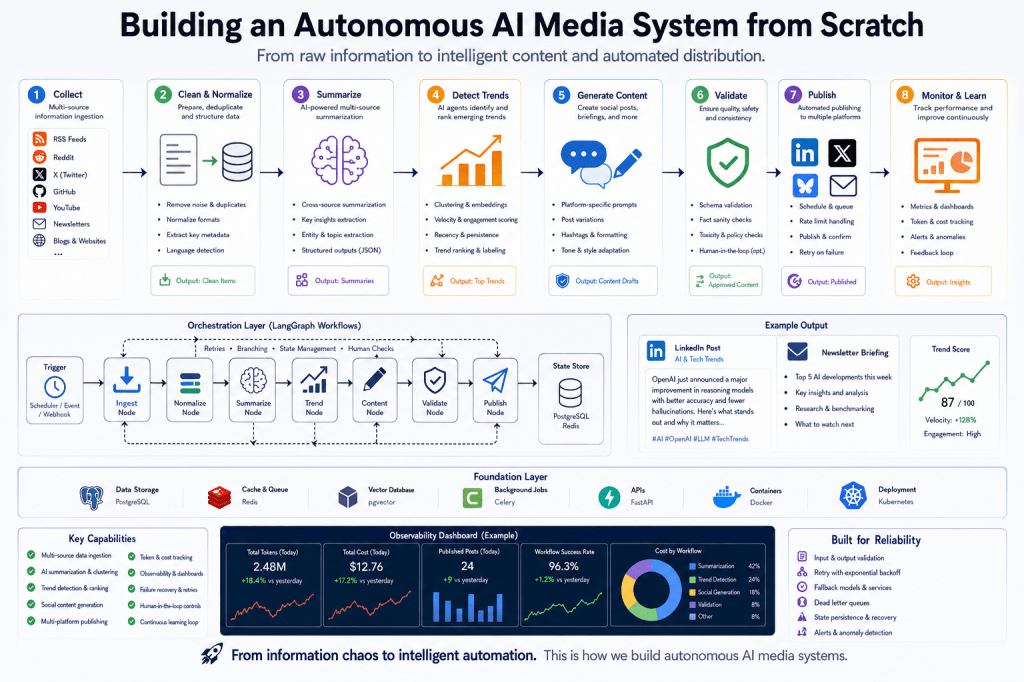
This article combines the core architectural lessons from our first major series into a single blueprint for building modern agentic AI systems.
The Shift from AI Prompts to AI Systems
Most AI tutorials focus on:
- prompts
- single API calls
- isolated demos
Real-world AI systems require much more:
- orchestration
- memory
- retries
- observability
- validation
- infrastructure
- scheduling
- reliability engineering
A production AI workflow is rarely:
- one model call
Instead, it often becomes:
- dozens of coordinated workflows operating continuously.
This is where autonomous AI systems emerge.
What Is an Autonomous AI Media System?
An autonomous AI media system is a continuously operating pipeline that:
- collects information
- processes data
- reasons about trends
- generates content
- distributes outputs
- monitors performance
- recovers from failures
These systems combine:
- AI reasoning
- orchestration
- infrastructure engineering
- automation
- observability
into one operational architecture.
High-Level System Architecture
A simplified autonomous AI media pipeline looks like this:
Information Sources ↓Ingestion Pipelines ↓Cleaning & Normalization ↓Deduplication & Clustering ↓AI Summarization ↓Trend Detection ↓Social Media Generation ↓Validation ↓Publishing Systems ↓Observability & Monitoring
Each layer introduces different engineering challenges.
Step 1 — Collecting Information
Every AI media system begins with ingestion.
The system continuously collects information from:
This creates the raw information stream.
Why Ingestion Matters
Without reliable ingestion:
- AI summaries become outdated
- trend detection fails
- workflows lose relevance
- automation pipelines collapse
Production AI systems depend heavily on data quality.
Recommended Technologies
Typical ingestion tools include:
- Playwright
- BeautifulSoup
- feedparser
- API clients
These systems normalize external data into structured formats.
Step 2 — Cleaning and Normalization
Internet data is noisy.
The preprocessing layer removes:
- duplicates
- malformed text
- advertisements
- irrelevant content
- inconsistent formatting
Example Normalized Structure
{ "source": "reddit/artificial", "title": "New AI Model Released", "content": "...", "author": "user123"}
Normalization creates predictable downstream workflows.
Why This Layer Is Critical
Poor preprocessing causes:
- hallucinations
- repetitive summaries
- incorrect rankings
- wasted tokens
In many systems, preprocessing quality matters more than prompt engineering.
Step 3 — Multi-Source AI Summarization
Once content is cleaned, AI systems summarize discussions across multiple sources.
This is significantly more difficult than single-document summarization.
The system must:
- merge perspectives
- remove duplicates
- preserve factual accuracy
- identify important signals
Example Workflow
RSS Articles ↓Reddit Discussions ↓X Reactions ↓Clustered Topic ↓AI Summary
This transforms fragmented discussions into usable intelligence.
Why Structured Outputs Matter
Production systems increasingly rely on structured outputs using:
- Pydantic
- JSON schemas
- typed validation
Example:
class SummaryOutput(BaseModel): headline: str summary: str
Structured outputs improve:
- automation
- validation
- orchestration reliability
Step 4 — Orchestrating AI Workflows with LangGraph
As workflows grow more complex, orchestration becomes essential.
Modern AI pipelines require:
- retries
- branching logic
- state management
- long-running execution
- memory systems
- human approval checkpoints
This is where LangGraph becomes extremely valuable.
Example Workflow Graph
Collect News ↓Summarize Articles ↓Rank Stories ↓Generate Social Posts ↓Validate ↓Publish
LangGraph coordinates:
- state
- transitions
- retries
- conditional routing
This transforms isolated AI calls into operational workflows.
Step 5 — Detecting Trends with AI Agents
Once summaries exist, the system begins identifying trends.
Trend detection combines:
- engagement signals
- velocity
- clustering
- AI reasoning
- ranking systems
Example Trend Signals
The system may track:
- Reddit upvotes
- repost velocity
- GitHub activity
- source diversity
- recency
- persistence
This helps identify:
- emerging discussions
- accelerating topics
- important industry developments
before they become mainstream.
Why Trend Detection Matters
Trend systems transform:
- raw information
into:
- operational awareness
This is one of the most powerful use cases for agentic AI systems.
Step 6 — AI-Powered Social Media Generation
Once trends are identified, the system can automatically generate:
- LinkedIn posts
- X updates
- Bluesky posts
- newsletters
- AI briefings
Different platforms require:
- different tones
- different formats
- different lengths
Example Social Workflow
Trend Detection ↓Generate Summary ↓Platform-Specific Prompts ↓AI Social Posts ↓Validation ↓Publishing Queue
This creates autonomous publishing infrastructure.
Why Validation Is Essential
AI systems can:
- hallucinate facts
- generate misleading content
- produce repetitive posts
Production systems require:
- validation layers
- moderation systems
- approval workflows
before publishing automatically.
Step 7 — Tracking Token Costs
As AI systems scale, token observability becomes critical.
Every workflow consumes tokens:
- summarization
- embeddings
- validation
- retries
- memory systems
Without monitoring:
- costs become unpredictable
- retries become dangerous
- workflows become inefficient
Example Token Monitoring
{ "workflow": "daily_ai_briefing", "tokens_used": 182493, "estimated_cost": 2.84}
This transforms AI systems into measurable operational infrastructure.
Why Observability Matters
Production systems monitor:
- token usage
- latency
- failures
- retries
- workflow duration
- API costs
AI engineering increasingly overlaps with infrastructure engineering.
Step 8 — Failure Recovery
Autonomous systems fail constantly.
Examples include:
- API outages
- malformed outputs
- retry storms
- queue failures
- hallucinated structures
- infrastructure instability
Reliable systems require recovery mechanisms.
Example Recovery Architecture
Workflow Failure ↓Validation ↓Retry Engine ↓Fallback Logic ↓Dead Letter Queue
This prevents workflows from collapsing under real-world instability.
Why Reliability Engineering Matters
The more autonomous a system becomes:
- the more failures it encounters
- the more resilience it requires
Production AI systems increasingly resemble distributed cloud systems.
The Rise of Agentic Systems
The AI industry is shifting toward:
- orchestrated workflows
- autonomous agents
- long-running systems
- operational AI infrastructure
This is fundamentally different from:
- isolated prompts
- static chatbots
- one-off API calls
Modern AI engineering now involves:
- orchestration
- observability
- infrastructure
- reliability
- workflow coordination
Recommended Technology Stack
A modern autonomous AI media system may use:
AI Layer
Backend
Crawling
- Playwright
- feedparser
- BeautifulSoup
Workflow Infrastructure
- Celery
- APScheduler
- queue systems
Monitoring
Deployment
- Docker
- cloud workers
- async infrastructure
Together, these tools form the foundation of modern AI operations.
Why This Matters Beyond Media
Although we focus on media systems, these same architectural patterns apply to:
- enterprise automation
- AI copilots
- operational intelligence
- autonomous research agents
- monitoring systems
- AI orchestration platforms
Media systems are simply an ideal environment for learning modern AI infrastructure engineering.
The Future of AI Engineering
The future of AI is not only:
- larger models
- better prompts
It is also:
- orchestration
- reliability
- observability
- autonomous coordination
- infrastructure engineering
AI applications are evolving into continuously operating systems.
Understanding how those systems work is becoming one of the most important skills in applied AI.
Final Thoughts
Building autonomous AI systems requires far more than calling an LLM API.
Real systems combine:
- ingestion pipelines
- orchestration frameworks
- trend detection
- structured outputs
- publishing systems
- observability
- recovery infrastructure
into one coordinated operational architecture.
At AgenticMediaLab, we are documenting that evolution publicly:
- the successes
- the failures
- the redesigns
- the infrastructure decisions
- the operational tradeoffs
because the future of AI engineering is not just about models.
It is about systems.
Recommended First 10 Articles
I recommend to read the following 10 articles to get a better insight of the project and what we are trying to achieve.
- “Why We Built AgenticMediaLab”
- “Architecture of an Autonomous AI News Pipeline”
- “Pulling AI News from X, Reddit, and RSS with Python”
- “Building a Multi-Source AI Summarization System”
- “Using LangGraph to Orchestrate AI Media Workflows”
- “Structured AI Outputs with Pydantic AI”
- “Designing an AI Agent That Detects Trending Topics”
- “How We Automatically Generate Social Media Posts with AI”
- “Tracking Token Costs in Autonomous AI Pipelines”
- “Failure Recovery in AI Agent Systems”
👉 You can experiment with a practical AI News System implementation of this concept in the official GitHub repository for the AgenticMediaLab: https://github.com/BenardoKemp/agentic-media-lab
 Agentic Media Lab