Artificial intelligence is entering a new phase.
For years, most AI tutorials focused on isolated prompts, toy examples, and disconnected demos. You could generate text, summarize an article, or ask a chatbot a question—but very few resources showed how to build complete AI systems that actually operate in the real world.
That gap is exactly why we created AgenticMediaLab.
This website is dedicated to building autonomous AI media systems in public.
Not theoretical systems.
Not polished marketing diagrams.
Real systems.
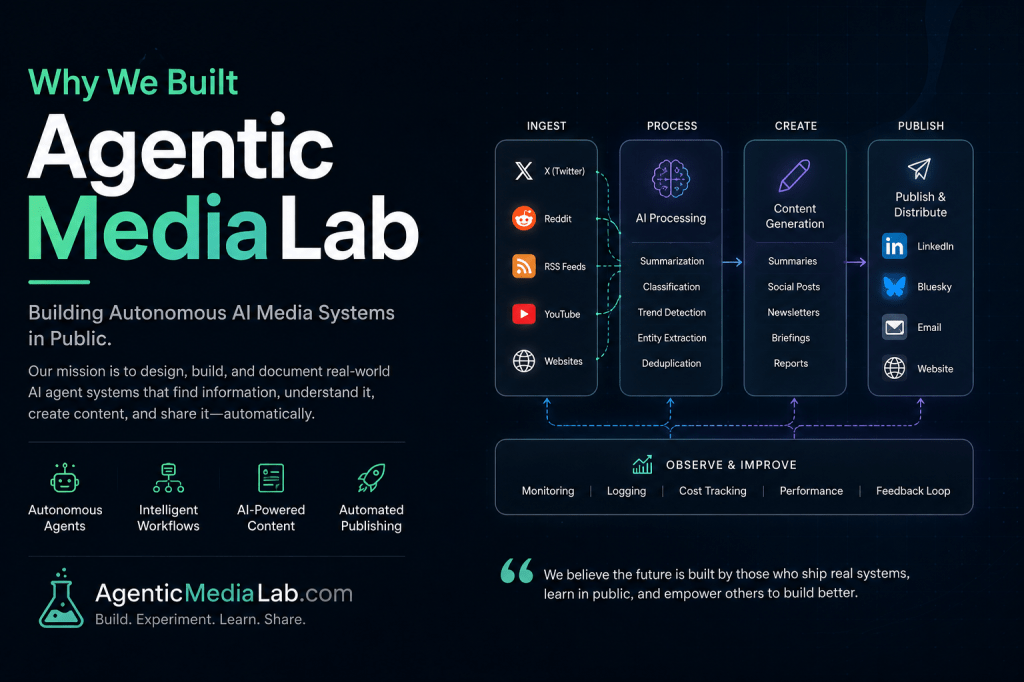
Systems that ingest information, process content, detect trends, summarize discussions, generate media, publish updates, recover from failures, and continuously evolve over time.
The goal is simple:
To document how modern AI agents can be engineered into operational pipelines that perform meaningful work.
The Shift from AI Tools to AI Systems
The AI industry is rapidly moving beyond single prompts and isolated chatbot interactions.
Today’s most interesting AI applications are systems composed of multiple moving parts:
- crawlers
- workflows
- memory
- orchestration layers
- retrieval systems
- structured outputs
- queues
- monitoring
- retry logic
- multi-agent coordination
In other words:
AI is becoming infrastructure.
A single LLM call is no longer enough.
Real-world AI applications increasingly require:
- persistent state
- autonomous workflows
- error handling
- observability
- scheduling
- external tools
- long-running processes
- decision pipelines
This is where “agentic systems” begin.
AgenticMediaLab exists to explore this transition.
Why Media Systems?
Media systems are one of the best ways to understand agentic AI.
A modern AI media pipeline touches almost every important engineering problem in applied AI:
Information Ingestion
Pulling content from:
AI Processing
Transforming raw information into:
- summaries
- classifications
- embeddings
- rankings
- trend detection
- topic clusters
Workflow Orchestration
Managing:
- retries
- branching logic
- state
- memory
- scheduling
- human approval checkpoints
Content Generation
Creating:
- newsletters
- social media posts
- AI briefings
- blog drafts
- research digests
Distribution
Publishing content across:
- websites
- APIs
- social platforms
- automation pipelines
Observability
Tracking:
- token usage
- latency
- costs
- hallucinations
- failures
- throughput
This makes autonomous media systems an ideal playground for learning practical AI engineering.
The Problem with Most AI Tutorials
Many AI tutorials stop too early.
They show:
- a prompt
- a single API call
- a chatbot response
But production systems are not built from isolated prompts.
They are built from workflows.
The difficult parts are usually:
- coordination
- reliability
- scaling
- recovery
- validation
- orchestration
- data quality
- cost management
Those are the topics we want to focus on here.
AgenticMediaLab is not just about generating AI content.
It is about engineering systems that can operate continuously and reliably.
What We Will Build
This website will document the construction of a fully operational AI-powered media pipeline.
Over time, we will explore:
- AI news aggregation
- autonomous research systems
- trend analysis agents
- multi-agent workflows
- AI summarization pipelines
- structured AI outputs
- automated publishing systems
- observability frameworks
- cost optimization strategies
- long-running AI workflows
We will also publish:
- architecture diagrams
- implementation breakdowns
- production tradeoffs
- failure analysis
- debugging workflows
- infrastructure discussions
- deployment strategies
This is a build-in-public engineering project.
Not a static tutorial archive.
The Technologies Behind the Project
The stack behind AgenticMediaLab will evolve over time, but current areas of exploration include:
AI Frameworks
Backend Infrastructure
Crawling & Ingestion
Workflow & Scheduling
- Celery
- APScheduler
- queue-based systems
Observability
- logging systems
- tracing
- token accounting
- performance monitoring
Rather than pretending there is one perfect stack, we want to explore the tradeoffs between approaches.
Why “Agentic” Matters
The word “agentic” has quickly become one of the most discussed concepts in AI.
But many explanations remain vague.
To us, agentic systems are systems that:
- make decisions
- maintain state
- execute workflows
- coordinate tools
- recover from errors
- adapt over time
This is fundamentally different from static prompt-response interactions.
The future of applied AI will likely involve:
- long-running agents
- orchestrated workflows
- autonomous pipelines
- multi-system coordination
Understanding how these systems are designed is becoming increasingly important for developers, engineers, researchers, and creators.
Building in Public
One of the core principles behind AgenticMediaLab is transparency.
We will not only publish successes.
We will also publish:
- architectural mistakes
- failed experiments
- scaling problems
- hallucination issues
- workflow bottlenecks
- debugging sessions
- cost overruns
- reliability problems
Real AI systems are messy.
That reality is often missing from polished AI demos.
By documenting the engineering process openly, we hope to create a more useful educational resource for developers who want to build serious AI applications.
Who This Website Is For
AgenticMediaLab is designed for:
- AI engineers
- Python developers
- automation builders
- AI researchers
- technical founders
- workflow architects
- AI hobbyists
- developers exploring autonomous systems
Whether you are experimenting with your first AI pipeline or designing complex orchestration systems, the goal is to make the underlying engineering concepts practical and understandable.
The Bigger Vision
The long-term vision for AgenticMediaLab is larger than a single news aggregation project.
This website is ultimately about understanding how autonomous AI systems are engineered.
Media systems are only the starting point.
The same architectural principles apply to:
- research agents
- enterprise automation
- AI copilots
- monitoring systems
- data pipelines
- operational intelligence platforms
- autonomous business workflows
The AI industry is moving toward systems, not isolated prompts.
We want to document that transition as it happens.
Welcome to AgenticMediaLab
This is the beginning of an ongoing engineering experiment.
Over the coming months, we will design, build, test, break, rebuild, optimize, and scale real AI systems in public.
If you are interested in:
- agentic workflows
- autonomous AI pipelines
- AI orchestration
- practical AI engineering
- AI infrastructure
- media automation
- production AI systems
you are in the right place.
Welcome to AgenticMediaLab.
👉 You can experiment with a practical AI News System implementation of this concept in the official GitHub repository for the AgenticMediaLab: https://github.com/BenardoKemp/agentic-media-lab
 Agentic Media Lab