As AI systems become more complex, a single prompt is no longer enough.
Modern AI applications increasingly require:
- multiple reasoning steps
- conditional execution
- retries
- memory
- state management
- branching logic
- long-running workflows
- autonomous coordination
This is where orchestration becomes essential.
In autonomous AI media systems, orchestration is the layer that coordinates:
- ingestion
- summarization
- ranking
- validation
- publishing
- monitoring
Without orchestration, AI pipelines quickly become fragile, difficult to scale, and nearly impossible to debug.
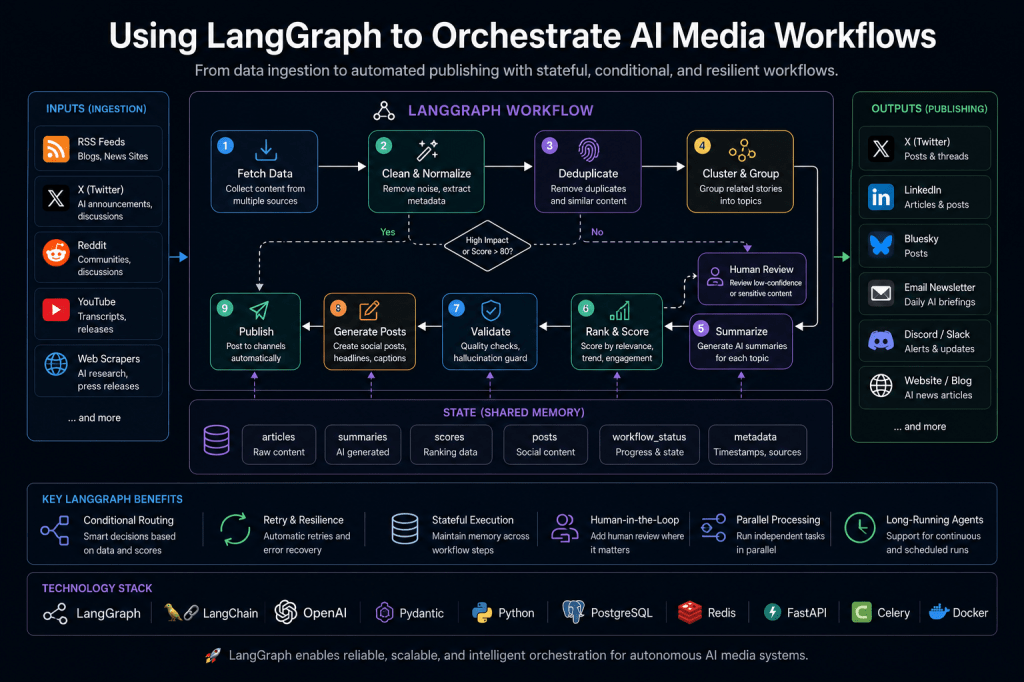
In this article, we will explore how to use LangGraph to orchestrate AI media workflows and build more reliable agentic systems.
What Is LangGraph?
LangGraph is a workflow orchestration framework designed for building stateful AI systems.
Rather than treating AI applications as isolated prompt calls, LangGraph models workflows as graphs composed of:
- nodes
- edges
- transitions
- state
This allows developers to create:
- branching workflows
- retry systems
- multi-step reasoning chains
- autonomous agents
- long-running processes
LangGraph is especially useful for agentic systems because real AI workflows are rarely linear.
Why Orchestration Matters in AI Media Systems
A production AI media pipeline may involve:
Ingestion ↓Cleaning ↓Deduplication ↓Clustering ↓Summarization ↓Ranking ↓Validation ↓Social Post Generation ↓Publishing
Each stage introduces:
- dependencies
- failures
- retries
- branching decisions
- asynchronous behavior
Without orchestration:
- pipelines become brittle
- retries become chaotic
- debugging becomes difficult
- workflows become tightly coupled
LangGraph solves this by explicitly modeling workflow state and transitions.
Core LangGraph Concepts
Before building workflows, it is important to understand several core concepts.
Nodes
Nodes are individual processing steps.
Examples:
- fetch RSS feeds
- summarize articles
- generate LinkedIn post
- validate summary
Edges
Edges define transitions between nodes.
They determine:
- what runs next
- which branch executes
- when workflows terminate
State
State is the shared data passed between workflow steps.
Example:
{ "articles": [...], "summaries": [...], "social_posts": [...]}
State is one of the most important parts of LangGraph.
It allows workflows to:
- accumulate information
- maintain memory
- coordinate decisions
- persist progress
Installing LangGraph
Install LangGraph using pip:
pip install langgraph langchain openai
Basic Workflow Architecture
Let us design a simple AI media workflow.
The workflow will:
- ingest AI news
- summarize content
- rank stories
- generate social media posts
Example Workflow Diagram
Fetch News ↓Summarize Articles ↓Rank Stories ↓Generate Social Posts ↓Publish
This is a simplified example, but the architecture scales well as systems grow.
Step 1 — Defining Workflow State
LangGraph workflows usually begin with a typed state object.
Example State Model
from typing import TypedDict, Listclass MediaState(TypedDict): articles: List[dict] summaries: List[str] ranked_articles: List[dict] social_posts: List[str]
This state object becomes the shared memory layer of the workflow.
Each node can:
- read from state
- modify state
- append new information
Step 2 — Creating Workflow Nodes
Each workflow step becomes a node.
Fetch News Node
def fetch_news(state): articles = [ { "title": "New Open Source AI Model Released", "content": "Developers discuss performance..." } ] state["articles"] = articles return state
Summarization Node
from openai import OpenAIclient = OpenAI()def summarize_articles(state): summaries = [] for article in state["articles"]: response = client.chat.completions.create( model="gpt-4.1-mini", messages=[ { "role": "system", "content": "Summarize AI news clearly." }, { "role": "user", "content": article["content"] } ] ) summaries.append( response.choices[0].message.content ) state["summaries"] = summaries return state
Ranking Node
def rank_articles(state): ranked = sorted( state["articles"], key=lambda x: len(x["content"]), reverse=True ) state["ranked_articles"] = ranked return state
Social Post Generation Node
def generate_social_posts(state): posts = [] for summary in state["summaries"]: post = f"AI Update: {summary}" posts.append(post) state["social_posts"] = posts return state
Step 3 — Building the Graph
Now we connect the workflow.
LangGraph Workflow Example
from langgraph.graph import StateGraphworkflow = StateGraph(MediaState)workflow.add_node("fetch_news", fetch_news)workflow.add_node("summarize", summarize_articles)workflow.add_node("rank", rank_articles)workflow.add_node("social", generate_social_posts)workflow.set_entry_point("fetch_news")workflow.add_edge("fetch_news", "summarize")workflow.add_edge("summarize", "rank")workflow.add_edge("rank", "social")app = workflow.compile()
This creates a fully connected workflow graph.
Step 4 — Running the Workflow
Once compiled, the workflow can execute with an initial state.
Execute Workflow
initial_state = { "articles": [], "summaries": [], "ranked_articles": [], "social_posts": []}result = app.invoke(initial_state)print(result["social_posts"])
This is the foundation of an orchestrated AI media system.
Why Graph-Based Workflows Matter
Traditional pipelines are usually linear.
Real AI systems are not.
AI workflows often require:
- retries
- fallback models
- conditional execution
- loops
- human review
- asynchronous tasks
Graph-based orchestration handles these patterns naturally.
Example Conditional Branching
Imagine:
- high-priority stories get published immediately
- low-priority stories enter human review
This becomes possible through conditional routing.
Conditional Workflow Example
def decide_publish_route(state): if len(state["ranked_articles"]) > 5: return "auto_publish" return "manual_review"
This transforms static pipelines into adaptive systems.
Retries and Failure Recovery
Production AI systems fail constantly.
Failures include:
- API timeouts
- malformed outputs
- token limit errors
- scraping failures
- invalid JSON
- hallucinated structures
LangGraph workflows make retries easier to coordinate.
Example Retry Strategy
try: result = summarize_articles(state)except Exception: print("Retrying summarization...")
In production systems, retries are usually:
- queued
- logged
- monitored
- rate limited
This becomes part of the orchestration architecture.
Adding Human-in-the-Loop Review
Not every workflow should be fully autonomous.
AI media systems often require:
- editorial review
- hallucination checks
- approval systems
LangGraph supports workflows where:
- AI pauses
- humans review outputs
- workflows resume later
This is extremely important for operational reliability.
State Persistence
One of the biggest advantages of LangGraph is stateful execution.
Workflows can maintain:
- summaries
- intermediate reasoning
- previous decisions
- workflow history
This enables:
- long-running agents
- memory systems
- autonomous loops
- adaptive workflows
Stateful systems are one of the defining characteristics of modern agentic AI.
Recommended Production Stack
A production AI orchestration system may combine:
AI Layer
Backend
- FastAPI
- PostgreSQL
- Redis
Scheduling
- Celery
- APScheduler
Monitoring
- tracing
- logging
- token accounting
Deployment
- Docker
- cloud workers
- async infrastructure
LangGraph becomes the coordination layer between all these systems.
Common Workflow Challenges
Workflow Explosion
Too many branching paths become difficult to manage.
State Complexity
Large state objects become hard to debug.
Retry Storms
Bad retry logic can overload systems.
Latency
Multi-step workflows increase response time.
Observability
Without tracing, debugging becomes difficult.
Hallucinated Outputs
Structured validation becomes essential.
These are orchestration problems, not just model problems.
Why LangGraph Fits AI Media Systems Well
AI media systems naturally involve:
- sequences
- decisions
- branching
- retries
- memory
- scheduling
- coordination
This makes graph orchestration highly effective.
LangGraph helps transform:
- disconnected AI scripts
into:
- operational AI systems
That transition is one of the defining engineering shifts happening in AI right now.
Final Thoughts
Modern AI systems are increasingly becoming workflow systems.
The future of applied AI is not only:
- better prompts
- larger models
It is also:
- orchestration
- state management
- reliability engineering
- adaptive workflows
- autonomous coordination
LangGraph provides a strong foundation for building these systems.
By combining:
- ingestion pipelines
- AI summarization
- workflow orchestration
- validation
- publishing systems
developers can create autonomous AI media architectures capable of operating continuously at scale.
In future articles, we will continue building this system with:
- structured outputs
- trend detection agents
- publishing pipelines
- observability systems
- failure recovery workflows
- autonomous AI coordination
This is where AI applications evolve into true agentic systems.
👉 You can experiment with a practical AI News System implementation of this concept in the official GitHub repository for the AgenticMediaLab: https://github.com/BenardoKemp/agentic-media-lab
 Agentic Media Lab