As AgenticMediaLab continues evolving, the platform now contains:
- AI agents
- LangGraph workflows
- Redis queues
- PostgreSQL databases
- pgvector memory
- trend ranking engines
- self-healing infrastructure
However, there is still a major limitation.
Most functionality currently exists inside:
Python Scripts
Scripts are useful for development.
Production systems require something more powerful.
They require:
APIs
Application Programming Interfaces allow other systems to:
- trigger workflows
- retrieve results
- submit jobs
- query memory
- publish content
- monitor infrastructure
In this article, we will build the first FastAPI service for AgenticMediaLab.
This marks a major architectural transition from:
- workflow execution
toward:
- AI platform services.
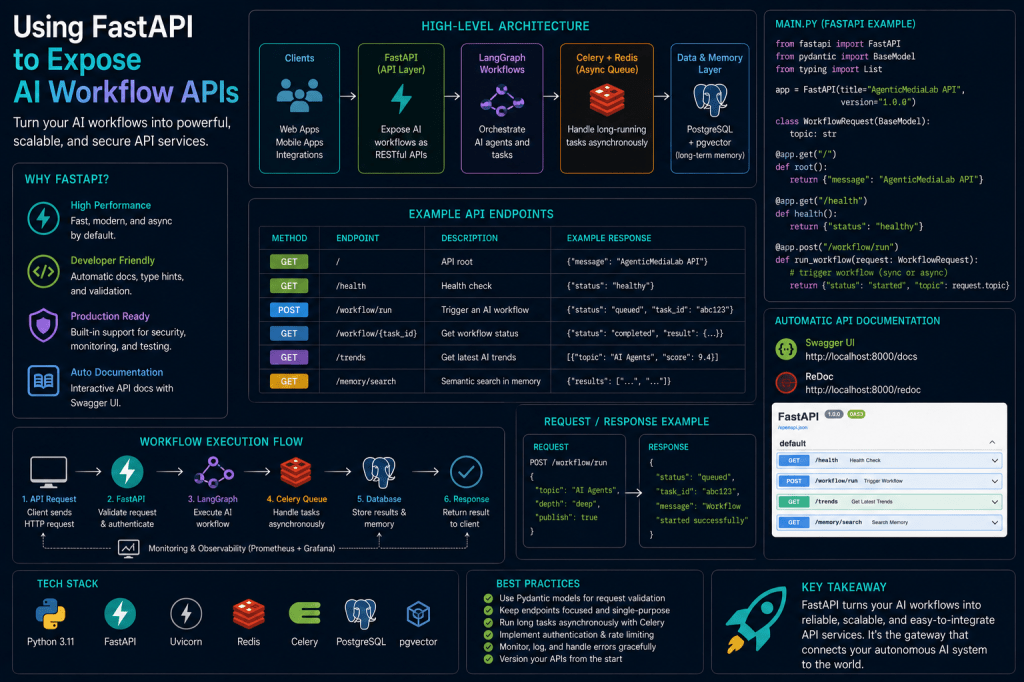
Why FastAPI?
FastAPI has become one of the most popular Python frameworks for:
- AI systems
- machine learning services
- autonomous agents
- microservices
- backend APIs
FastAPI provides:
- speed
- simplicity
- automatic documentation
- type safety
- async support
It is an excellent fit for AgenticMediaLab.
Why APIs Matter
Without APIs:
Workflow ↓Manual Execution
With APIs:
Workflow ↓Service Endpoint ↓External Applications
This dramatically increases flexibility.
High-Level Architecture
The platform now evolves into:
Clients ↓FastAPI ↓LangGraph Workflows ↓Redis + Celery ↓PostgreSQL + pgvector
FastAPI becomes the front door of the system.
Repository Structure
Create:
api/│├── main.py├── routes/│├── models/│├── services/│└── schemas/
This becomes the API layer.
Installing FastAPI
Install dependencies:
pip install fastapi uvicorn
FastAPI handles:
- API routing
- validation
- serialization
Uvicorn becomes the web server.
Creating the First API
Create:
api/main.py
Example:
from fastapi import FastAPIapp = FastAPI()
The application now exists.
Creating the First Route
Add:
app.get("/")def root(): return { "message": "AgenticMediaLab API" }
Simple but important.
Running the API
Start the server:
uvicorn api.main:app --reload
Example output:
Application startup complete
The API is now running.
Testing the Endpoint
Open:
http://localhost:8000
Response:
{ "message": "AgenticMediaLab API"}
The first AI platform endpoint is operational.
Why FastAPI Is Popular
FastAPI automatically generates:
- OpenAPI specifications
- Swagger documentation
- validation schemas
This significantly reduces development effort.
Automatic API Documentation
Visit:
http://localhost:8000/docs
FastAPI automatically creates:
- interactive API documentation
- request testing
- endpoint exploration
This feature is extremely useful.
Creating a Health Endpoint
Production systems require health checks.
Add:
app.get("/health")def health(): return { "status": "healthy" }
Response:
{ "status": "healthy"}
Monitoring systems can now verify uptime.
Why Health Checks Matter
Prometheus and Grafana can monitor:
/health
to determine:
- service availability
- infrastructure status
- deployment success
Health endpoints are standard production practice.
Creating a Workflow Endpoint
The next step:
trigger workflows through an API.
Example:
app.post("/workflow/run")def run_workflow(): return { "workflow": "started" }
The API can now trigger AI execution.
Why Workflow APIs Matter
Instead of:
Run Python Script
users can now:
Send HTTP Request
This enables:
- web applications
- dashboards
- automation tools
- integrations
Adding Request Models
Create:
api/models/workflow.py
Example:
from pydantic import BaseModelclass WorkflowRequest( BaseModel): topic: str
This creates structured inputs.
Why Validation Matters
Without validation:
Invalid Data
causes failures.
With validation:
Structured Data
improves reliability.
FastAPI automatically validates incoming requests.
Creating a Topic Endpoint
Example:
from models.workflow import WorkflowRequestapp.post("/topic")def process_topic( request: WorkflowRequest): return { "topic": request.topic }
Test:
{ "topic": "AI Agents"}
Response:
{ "topic": "AI Agents"}
Connecting LangGraph
Soon API requests will trigger workflows.
Example:
from workflows.graph import graphapp.post("/workflow/run")def execute( request: WorkflowRequest): result = graph.invoke( { "topic": request.topic } ) return result
This exposes workflow execution through an API.
Connecting Celery
Long-running workflows should be asynchronous.
Example:
publish_task.delay( request.topic)
Response:
{ "status": "queued"}
This improves scalability.
Why Async APIs Matter
Some AI workflows take:
- seconds
- minutes
- longer
Blocking requests create poor user experiences.
Queues improve responsiveness.
Creating a Memory Endpoint
The memory system can also be exposed.
Example:
app.get("/memory/search")def search_memory( query: str):
The endpoint may:
- generate embeddings
- query pgvector
- return relevant memories
This creates memory-as-a-service.
Creating a Trend Endpoint
Example:
app.get("/trends")def get_trends():
Response:
[ { "topic": "AI Agents", "score": 9.4 }]
The trend engine becomes accessible externally.
Authentication
Public APIs require protection.
Example:
from fastapi.security import APIKeyHeader
Future improvements include:
- API keys
- JWT tokens
- OAuth
Security becomes increasingly important.
API Versioning
As systems evolve:
/api/v1//api/v2/
Versioning prevents:
- breaking clients
- deployment issues
- upgrade problems
Production APIs typically version early.
Dockerizing FastAPI
Update:
FROM python:3.11WORKDIR /appCOPY requirements.txt .RUN pip install -r requirements.txtCOPY . .CMD [ "uvicorn", "api.main:app", "--host", "0.0.0.0", "--port", "8000"]
The API becomes deployable.
Updating Docker Compose
Add:
api: build: context: . ports: - "8000:8000"
FastAPI now becomes part of the infrastructure stack.
Observability
Track:
- request count
- latency
- failures
- workflow execution time
Metrics:
api_requests_totalapi_failures_totalapi_latency_seconds
This integrates nicely with Prometheus.
Example Future Architecture
The platform is evolving toward:
Clients ↓FastAPI ↓AI Agents ↓LangGraph ↓Memory Layer ↓Publishing Layer
This resembles a true AI platform.
Why APIs Are a Major Milestone
Without APIs:
Internal Workflows
With APIs:
Platform Services
The distinction is significant.
The platform becomes usable by:
- dashboards
- applications
- integrations
- external users
Common Beginner Mistake
Many developers expose:
Everything
through APIs.
A better strategy is:
- expose only necessary functionality
- validate inputs
- secure endpoints
- monitor usage
Good API design improves maintainability.
Future Improvements
The API layer will eventually support:
- workflow scheduling
- memory retrieval
- multi-agent coordination
- publishing triggers
- authentication
- rate limiting
- WebSockets
This moves toward:
- AI Platform Engineering.
What Comes Next
The next infrastructure layers will introduce:
- semantic search APIs
- agent communication APIs
- distributed orchestration
- autonomous planning services
- memory-aware agents
The platform is steadily evolving toward:
- a fully operational AI ecosystem.
Final Thoughts
FastAPI is one of the most important tools in modern AI engineering.
It transforms:
- workflows
into:
- services
and
- scripts
into:
- platforms.
By introducing FastAPI, AgenticMediaLab gains:
- API access
- workflow execution endpoints
- memory services
- trend services
- operational interfaces
This is where the project begins evolving from an autonomous workflow collection into a true AI platform.
 Agentic Media Lab