As AgenticMediaLab continues evolving, one major limitation becomes increasingly apparent.
Most AI systems suffer from a form of amnesia.
They can:
- reason
- summarize
- analyze
- generate content
but once a workflow finishes, the experience is often lost.
The next time the system runs, it starts over from scratch.
Humans do not operate this way.
We learn from:
- previous decisions
- past experiences
- successes
- failures
Autonomous AI systems require similar capabilities.
This is where long-term memory becomes one of the most important architectural layers in modern AI infrastructure.
In this article, we will build the first long-term memory system for AgenticMediaLab using:
- PostgreSQL
- pgvector
- embeddings
- semantic retrieval
- memory management
This is where the platform begins evolving from:
- workflow automation
into:
- continuously learning autonomous systems.
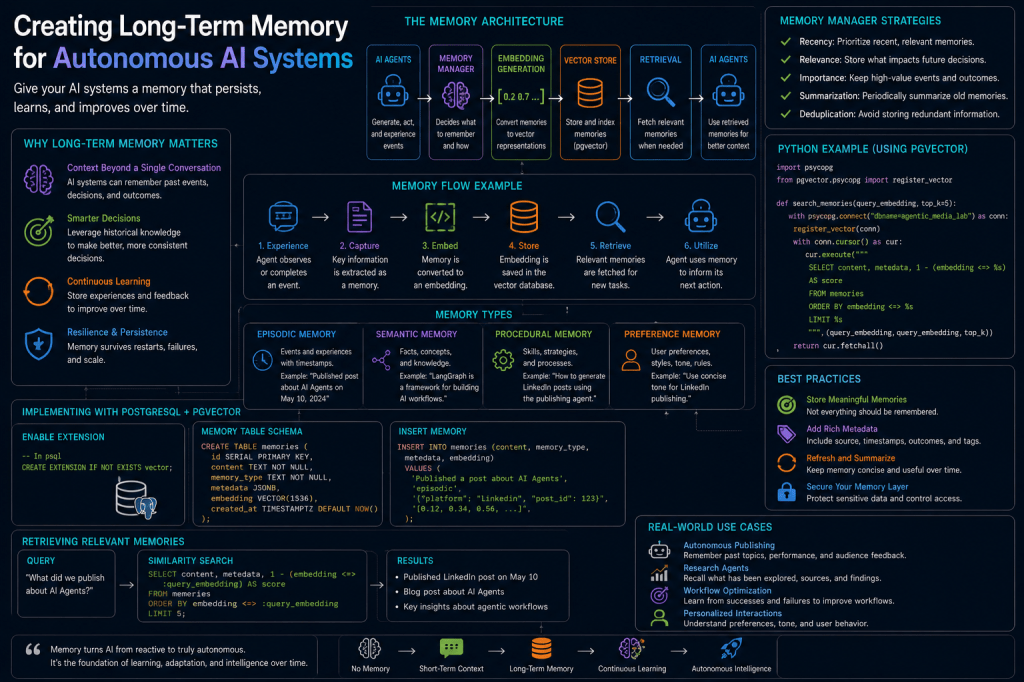
Why AI Systems Need Memory
Without memory:
Input ↓Process ↓Output ↓Forget Everything
The system repeatedly solves the same problems.
With memory:
Input ↓Process ↓Store Experience ↓Retrieve Experience ↓Improve Future Decisions
This creates:
- continuity
- learning
- adaptation
What Is Long-Term Memory?
Long-term memory allows AI systems to remember:
- previous conversations
- generated content
- workflow outcomes
- user preferences
- successful strategies
- operational history
The memory persists beyond a single execution.
Memory vs Context Windows
Many developers confuse:
- context windows
- memory systems
They are very different.
Context Window
Exists only during execution.
Example:
Current Prompt
Once finished:
Memory Lost
Long-Term Memory
Persists indefinitely.
Example:
JanuaryFebruaryMarchApril
The system can recall information months later.
Types of AI Memory
Most autonomous systems eventually require multiple memory types.
Episodic Memory
Stores experiences.
Examples:
- published LinkedIn post
- workflow failure
- successful trend analysis
Think:
What happened?
Semantic Memory
Stores facts and knowledge.
Examples:
- LangGraph is a workflow framework
- PostgreSQL supports pgvector
Think:
What do I know?
Procedural Memory
Stores processes.
Examples:
- how to generate LinkedIn posts
- how to summarize articles
Think:
How do I perform a task?
Preference Memory
Stores preferences.
Examples:
- preferred writing style
- publishing cadence
- topic priorities
Think:
How should I behave?
Memory Architecture
The AgenticMediaLab memory layer looks like:
AI Agent ↓Memory Manager ↓Embeddings ↓pgvector ↓PostgreSQL
This becomes:
- persistent semantic memory.
Repository Structure
Create:
memory/│├── memory_manager.py├── store_memory.py├── retrieve_memory.py├── memory_types.py└── memory_search.py
This becomes the memory subsystem.
Creating the Memory Table
Update PostgreSQL schema.
CREATE TABLE memories ( id SERIAL PRIMARY KEY, content TEXT NOT NULL, memory_type TEXT NOT NULL, metadata JSONB, embedding VECTOR(1536), created_at TIMESTAMP DEFAULT NOW());
This becomes:
- the long-term memory database.
Why Metadata Matters
Metadata allows memories to contain:
{ "source": "linkedin", "topic": "AI Agents", "confidence": 0.92}
This improves:
- filtering
- retrieval
- context reconstruction
Creating the Memory Manager
Create:
memory/memory_manager.py
Example:
class MemoryManager: def store(self, memory): pass def retrieve(self, query): pass
The Memory Manager becomes the central access point.
Storing Memories
Create:
memory/store_memory.py
Example:
memory = { "content": "Published LinkedIn article about AI agents", "memory_type": "episodic"}
Before storage:
- generate embedding
- save embedding
- save metadata
Why Use Embeddings?
Keyword search is limited.
Example:
AI Agent
and
Autonomous Assistant
may describe the same concept.
Embeddings capture:
- semantic meaning
rather than:
- exact words.
Generating Memory Embeddings
Example:
from openai import OpenAIclient = OpenAI()response = client.embeddings.create( model="text-embedding-3-small", input=memory["content"])embedding = response.data[0].embedding
This creates:
- semantic memory representations.
Storing Memories in PostgreSQL
Example:
INSERT INTO memories ( content, memory_type, embedding)VALUES (%s, %s, %s)
The memory now becomes:
- persistent
- searchable
- retrievable
Retrieving Relevant Memories
Create:
memory/retrieve_memory.py
Example:
query ="AI agents and workflow orchestration"
Generate query embedding:
query_embedding = ...
Then search:
SELECT content, 1 - (embedding <=> %s)FROM memoriesORDER BY embedding <=> %sLIMIT 5;
This retrieves:
- semantically similar memories.
Why Semantic Retrieval Matters
The system no longer searches for:
Exact Words
It searches for:
Similar Meaning
This dramatically improves:
- recall
- relevance
- intelligence
Example Memory Retrieval
Suppose the system asks:
Have we written about AI agents before?
The memory layer may return:
Published LinkedIn articleCreated trend analysisGenerated blog post
even if the wording differs.
Memory Lifecycle
Not all memories should live forever.
A memory lifecycle is important.
Capture ↓Store ↓Retrieve ↓Update ↓Archive
This prevents:
- memory overload
- database bloat
Memory Importance Scoring
Every memory can receive a score.
Example:
importance = 9.2
High-value memories:
- strategic decisions
- major failures
- successful outcomes
remain longer.
Memory Summarization
Over time:
10,000 memories become difficult to manage.
A future memory agent may periodically create:
Memory Summary
from:
100 Similar Memories
This keeps memory efficient.
Example Future Workflow
The future system may look like:
Research Agent ↓Memory Retrieval ↓Context Building ↓Reasoning ↓Decision ↓Memory Storage
The system continuously learns.
Memory and Multi-Agent Systems
Soon multiple agents will share:
Shared Memory Layer
Architecture:
Research AgentSummarization AgentTrend AgentPublishing Agent ↓Shared Memory
This enables:
- collaboration
- context sharing
- coordination
Why Long-Term Memory Is a Turning Point
Without memory:
AI systems remain reactive.
With memory:
AI systems become adaptive.
This is one of the biggest architectural transitions in autonomous AI.
Common Beginner Mistake
Many developers attempt:
Store Everything
This quickly becomes:
- expensive
- noisy
- inefficient
Good memory systems focus on:
- relevance
- importance
- retrievability
not volume.
Future Improvements
The memory layer will eventually support:
- memory pruning
- memory consolidation
- memory reflection
- episodic learning
- preference adaptation
- autonomous memory management
This moves toward:
- continuously improving AI systems.
Why Memory Changes Everything
Long-term memory transforms AI systems from:
Reactive
into:
Experience-Based
The system begins learning from:
- past actions
- prior outcomes
- accumulated knowledge
This is a fundamental shift.
What Comes Next
The next infrastructure layers will introduce:
- self-healing workflows
- autonomous planning systems
- agent supervision
- memory-aware reasoning
- adaptive decision making
- persistent AI organizations
The platform is evolving toward:
- a true autonomous AI ecosystem.
Final Thoughts
Long-term memory is one of the most important capabilities required for autonomous AI systems.
It enables:
- continuity
- learning
- adaptation
- collaboration
- intelligence over time
By combining:
- PostgreSQL
- pgvector
- embeddings
- semantic retrieval
AgenticMediaLab now gains the foundation for persistent AI memory.
And memory is where autonomous systems begin to move beyond automation and toward genuine operational intelligence.
 Agentic Media Lab