Up until now, AgenticMediaLab has been built around a single autonomous workflow.
The platform can:
- collect information
- summarize content
- generate embeddings
- rank trends
- publish content
- monitor infrastructure
But there is an important limitation.
One workflow is still doing everything.
As AI systems grow, a single agent quickly becomes:
- overloaded
- difficult to maintain
- hard to scale
- increasingly brittle
This is where multi-agent systems become valuable.
Instead of one AI agent handling everything, we create:
- specialized agents
- focused responsibilities
- coordinated execution
In this article, we will build the first multi-agent coordination system for AgenticMediaLab.
This is where the platform begins evolving from:
- autonomous workflows
into:
- collaborative AI systems.
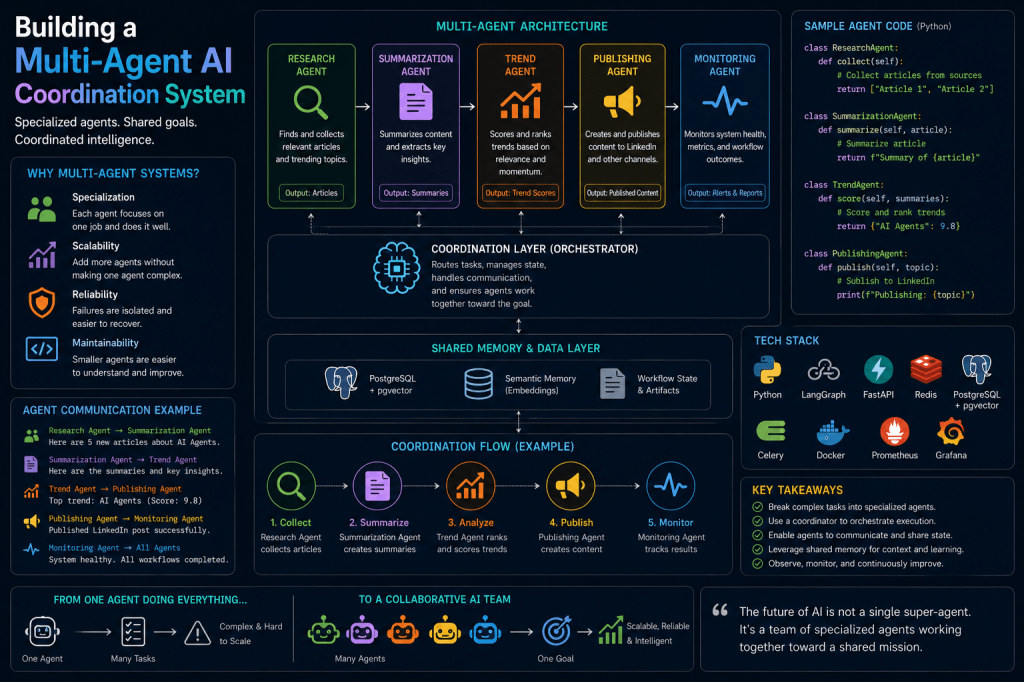
What Is a Multi-Agent System?
A multi-agent system consists of multiple specialized AI agents working together toward a common objective.
Instead of:
One Agent ↓Everything
we create:
Agent AAgent BAgent CAgent D ↓Coordination Layer
Each agent has:
- a role
- responsibilities
- inputs
- outputs
This mirrors how human teams operate.
Why Multi-Agent Systems Matter
As systems become more sophisticated:
One agent may struggle to:
- research
- summarize
- rank
- publish
- monitor
- recover failures
all simultaneously.
Specialization often improves:
- reliability
- scalability
- maintainability
- reasoning quality
AgenticMediaLab Multi-Agent Vision
Our future architecture may look like:
Research Agent ↓Summarization Agent ↓Trend Analysis Agent ↓Publishing Agent ↓Monitoring Agent
Each agent contributes to the overall system.
Why Not One Large Agent?
Large monolithic agents often suffer from:
- context overload
- prompt complexity
- reasoning drift
- difficult debugging
Smaller agents are easier to:
- understand
- monitor
- improve
- replace
This is similar to microservices in software engineering.
Repository Structure
Create:
agents/│├── research_agent.py├── summarization_agent.py├── trend_agent.py├── publishing_agent.py├── coordinator.py
This becomes the multi-agent layer.
Designing Agent Roles
The first step is defining responsibilities.
Research Agent
Responsible for:
- collecting articles
- retrieving news
- finding trends
- gathering sources
Input:
RSS feedsRedditSocial feeds
Output:
Relevant articles
Summarization Agent
Responsible for:
- summarizing content
- extracting insights
- creating concise descriptions
Input:
Article
Output:
Summary
Trend Agent
Responsible for:
- clustering topics
- ranking trends
- detecting momentum
Input:
SummariesEmbeddings
Output:
Trend scores
Publishing Agent
Responsible for:
- LinkedIn posts
- blog generation
- social content
Input:
Trend data
Output:
Published content
Building the First Agent
Create:
agents/research_agent.py
Example:
class ResearchAgent: def collect(self): return [ "OpenAI launches new agent framework", "New reasoning model announced" ]
Simple but effective.
Creating the Summarization Agent
class SummarizationAgent: def summarize(self, article): return f"Summary: {article}"
This agent focuses on one responsibility.
Creating the Trend Agent
class TrendAgent: def score(self, summaries): return { "AI Agents": 9.4 }
The trend agent analyzes importance.
Creating the Publishing Agent
class PublishingAgent: def publish(self, topic): print( f"Publishing content for {topic}" )
This agent handles distribution.
The Missing Piece: Coordination
Agents alone are not enough.
They need orchestration.
This is where the coordinator enters.
Building the Coordinator
Create:
agents/coordinator.py
Example:
from research_agent import ResearchAgentfrom summarization_agent import SummarizationAgentfrom trend_agent import TrendAgentfrom publishing_agent import PublishingAgent
Instantiate:
research = ResearchAgent()summary = SummarizationAgent()trend = TrendAgent()publisher = PublishingAgent()
Running the Workflow
articles = research.collect()summaries = []for article in articles: summaries.append( summary.summarize(article) )scores = trend.score(summaries)publisher.publish( list(scores.keys())[0])
The agents are now collaborating.
Visualizing Agent Communication
Research Agent ↓Summarization Agent ↓Trend Agent ↓Publishing Agent
This becomes the first coordinated AI team.
Why Coordination Is Hard
As more agents are added:
Challenges emerge:
- conflicting outputs
- state synchronization
- communication failures
- task duplication
Agent coordination becomes its own discipline.
Moving Beyond Sequential Agents
Our first system is linear.
Future systems may include:
Research Agent ↓ ┌───────────┐ ↓ ↓Summary Validation └────┬─────┘ ↓Trend Agent ↓Publishing Agent
This introduces:
- branching
- validation
- consensus
Agent-to-Agent Communication
Future agents may exchange:
{ "topic": "AI Agents", "confidence": 0.92}
Structured communication improves:
- reliability
- debugging
- observability
Introducing Shared Memory
Soon agents will share:
- PostgreSQL
- pgvector
- semantic memory
Architecture:
Agents ↓Shared Memory Layer ↓PostgreSQL + pgvector
This creates:
- persistent collaboration.
Why Multi-Agent Systems Scale Better
Instead of:
One Agent ↓10 Responsibilities
we create:
10 Agents ↓1 Responsibility Each
This improves:
- clarity
- maintenance
- scalability
Multi-Agent Systems and LangGraph
The next evolution is:
Agents ↓LangGraph ↓Workflow State ↓Coordination Logic
LangGraph becomes the orchestration engine.
Real-World Example
Imagine:
Research Agent finds:
New OpenAI model released
Summarization Agent creates:
Concise summary
Trend Agent determines:
Trend score = 9.8
Publishing Agent creates:
LinkedIn post
All autonomously.
Observability for Multi-Agent Systems
Each agent should track:
- execution time
- failures
- token usage
- success rates
Example metrics:
research_agent_runs_totalsummary_agent_runs_totaltrend_agent_runs_totalpublishing_agent_runs_total
Observability becomes increasingly important.
Common Beginner Mistake
Many developers create:
Super Agent
that does everything.
This often becomes:
- fragile
- expensive
- difficult to debug
Specialized agents are usually easier to scale.
Future Improvements
Future coordination systems may support:
- agent voting
- consensus mechanisms
- planning agents
- reflection agents
- supervisory agents
- autonomous retries
This moves toward:
- true agent societies.
Why This Is a Major Milestone
This article marks another architectural shift.
The platform is moving from:
Workflow Automation
toward:
Collaborative AI Systems
The distinction is important.
Workflows execute.
Agent teams collaborate.
What Comes Next
The next infrastructure layers will introduce:
- long-term memory
- semantic retrieval
- self-healing workflows
- autonomous planning
- agent supervision
- distributed coordination
The platform is evolving into:
- a true autonomous AI ecosystem.
Final Thoughts
Multi-agent systems represent one of the most important developments in modern AI engineering.
They allow systems to:
- specialize
- collaborate
- scale
- coordinate
By introducing:
- Research Agents
- Summarization Agents
- Trend Agents
- Publishing Agents
AgenticMediaLab takes its first step toward building a collaborative AI organization rather than a collection of isolated workflows.
This is where autonomous systems become truly interesting.
 Agentic Media Lab