At this stage, AgenticMediaLab has evolved into:
- ingestion pipelines
- async execution systems
- semantic embeddings
- trend ranking engines
- LangGraph orchestration workflows
The next logical step is:
autonomous publishing.
Because once an AI system can:
- collect information
- summarize content
- rank trends
- identify relevance
the natural question becomes:
Can the system publish content automatically?
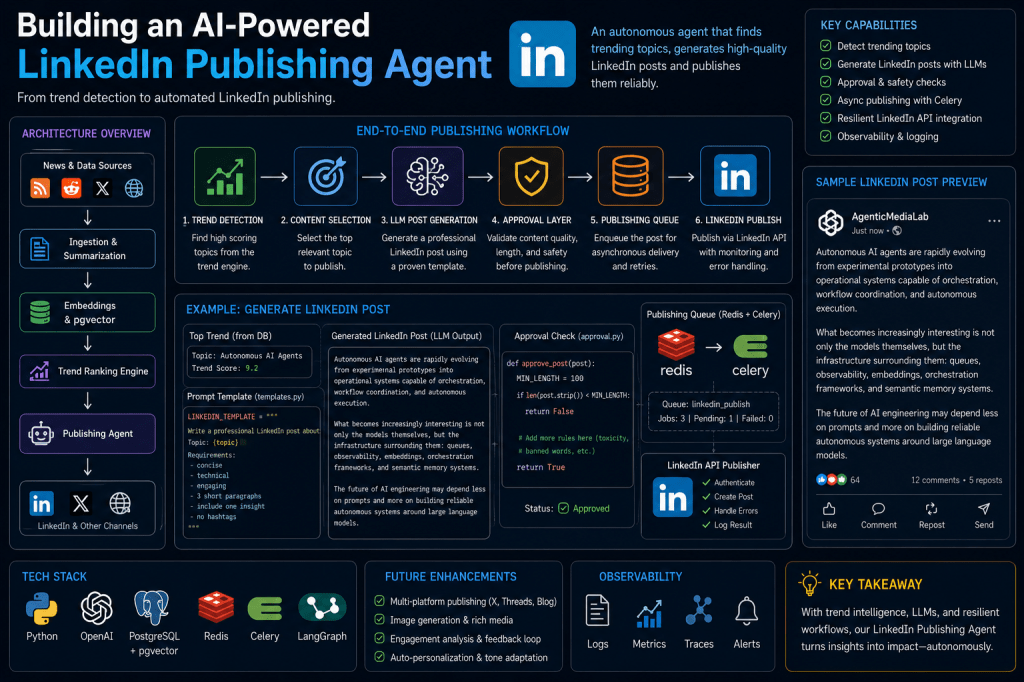
In this article, we will build the first AI-powered LinkedIn publishing agent for AgenticMediaLab.
The workflow will:
- monitor trends
- select relevant topics
- generate LinkedIn posts
- prepare publishing payloads
- orchestrate autonomous distribution workflows
This is where the platform begins evolving into:
- an autonomous media organization.
Why Publishing Agents Matter
Modern AI systems increasingly need to:
- distribute information
- generate content
- coordinate publishing workflows
- operate continuously
Without publishing layers:
- AI systems remain passive.
Publishing agents transform AI systems into:
- active communication platforms.
The Shift From Analysis to Action
Most AI systems stop at:
Analyze Information
But autonomous systems increasingly need:
Analyze ↓Decide ↓Publish
This introduces:
- operational autonomy
- workflow coordination
- automated communication systems
The platform is no longer simply processing data.
It is beginning to:
- participate in information distribution.
High-Level Publishing Architecture
The publishing workflow looks like this:
Trend Detection ↓Content Selection ↓LLM Post Generation ↓Approval Layer ↓Publishing Queue ↓LinkedIn Distribution
This becomes the first real:
- AI media agent.
Repository Structure
Create:
publishing/│├── linkedin/│ ├── generate_post.py│ ├── publish_agent.py│ ├── approval.py│ └── templates.py
This becomes the autonomous publishing layer.
Step 1 — Selecting Trending Topics
The publishing agent begins by selecting:
- high-scoring trends.
Create:
publishing/linkedin/generate_post.py
Example:
import psycopg2connection = psycopg2.connect( host="localhost", database="agentic_media_lab", user="postgres", password="password")cursor = connection.cursor()query = """SELECT topic, trend_scoreFROM trendsORDER BY trend_score DESCLIMIT 1"""cursor.execute(query)topic = cursor.fetchone()print(topic)
Example output:
("Autonomous AI Agents", 9.2)
The publishing agent now has:
- content direction.
Why Trend Ranking Matters
Without ranking systems:
- AI agents publish randomly.
Trend intelligence enables:
- prioritization
- relevance selection
- autonomous editorial decisions
This is where the system starts resembling:
- a media organization.
Step 2 — Creating a LinkedIn Prompt
Create:
publishing/linkedin/templates.py
Example:
LINKEDIN_TEMPLATE = """Write a professional LinkedIn post about:Topic:{topic}Requirements:- concise- technical- engaging- 3 short paragraphs- include one insight- no hashtags"""
This standardizes:
- post structure
- tone
- consistency
Why Templates Matter
Publishing agents require:
- editorial consistency
- formatting control
- platform adaptation
Templates become:
- workflow constraints for AI systems.
Step 3 — Generating the LinkedIn Post
Update:
publishing/linkedin/generate_post.py
Example:
from openai import OpenAIfrom templates import LINKEDIN_TEMPLATEclient = OpenAI()prompt = LINKEDIN_TEMPLATE.format( topic=topic[0])response = client.chat.completions.create( model="gpt-4o-mini", messages=[ { "role": "user", "content": prompt } ])linkedin_post = ( response .choices[0] .message .content)print(linkedin_post)
The publishing agent can now:
- generate social content autonomously.
Example Generated Output
Example:
Autonomous AI agents are rapidly evolving from experimental prototypes into operational systems capable of orchestration, workflow coordination, and autonomous execution.What becomes increasingly interesting is not only the models themselves, but the infrastructure surrounding them: queues, observability, embeddings, orchestration frameworks, and semantic memory systems.The future of AI engineering may depend less on prompts and more on building reliable autonomous systems around large language models.
This is:
- AI-generated publishing infrastructure.
Step 4 — Creating an Approval Layer
Autonomous systems should not immediately publish.
Add:
- approval workflows
- moderation layers
- validation systems
Create:
publishing/linkedin/approval.py
Example:
def approve_post(post): if len(post) < 100: return False return True
Why Approval Layers Matter
Autonomous publishing systems require:
- safeguards
- moderation
- reliability checks
Without validation:
- low-quality outputs
- hallucinations
- unsafe publishing
become major risks.
Step 5 — Publishing Queue
Publishing should be asynchronous.
Instead of:
Generate ↓Immediately Publish
the workflow becomes:
Generate ↓Validate ↓Queue ↓Publish
This enables:
- retries
- scheduling
- observability
- human review
Celery Integration
Example:
from tasks import publish_postpublish_post.delay( linkedin_post)
The publishing system now integrates into:
- distributed infrastructure.
Why Async Publishing Matters
Publishing APIs fail.
Examples:
- rate limits
- expired tokens
- API outages
- malformed payloads
Async queues provide:
- resilience
- retries
- operational reliability
Autonomous systems require fault tolerance.
Example Future Workflow
The architecture is evolving toward:
Collect News ↓Generate Embeddings ↓Rank Trends ↓Generate LinkedIn Post ↓Approval Layer ↓Publishing Queue ↓Social Distribution
This increasingly resembles:
- an autonomous AI newsroom.
LinkedIn API Integration
Eventually the system will integrate with:
- LinkedIn APIs
- OAuth authentication
- scheduled posting
Example future flow:
linkedin_client.publish( content=linkedin_post)
This transforms:
- AI workflows
into:
- autonomous media operations.
Why Social Distribution Matters
Autonomous systems increasingly need:
- output channels.
Without publishing:
- intelligence remains isolated.
Publishing agents create:
- operational feedback loops.
Observability for Publishing Agents
Publishing systems should track:
- generation latency
- approval rates
- publishing success
- engagement metrics
- token costs
- failure rates
Observability becomes critical for:
- autonomous communication systems.
Why This Is a Major Architectural Shift
This article marks another important transition.
The platform is evolving from:
- analysis infrastructure
into:
- autonomous action systems.
The AI platform can now:
- interpret information
- rank relevance
- generate communication
- coordinate publishing workflows
This is a major step toward:
- operational autonomy.
Common Beginner Mistake
Many AI projects stop at:
Generate content manually
But operational systems increasingly require:
- orchestration
- scheduling
- automated distribution
- validation
- retries
- publishing pipelines
The infrastructure complexity grows rapidly.
Future Improvements
The publishing agent will eventually support:
- multi-platform publishing
- content personalization
- semantic targeting
- automated image generation
- engagement optimization
- adaptive tone selection
This moves toward:
- fully autonomous AI media systems.
Why Autonomous Publishing Is So Powerful
Publishing agents transform AI systems from:
- passive analyzers
into:
- active communicators.
The system begins participating directly in:
- information ecosystems
- social platforms
- media distribution
This changes the role of AI systems entirely.
What Comes Next
The next infrastructure layers will introduce:
- autonomous image generation
- multi-agent coordination
- observability dashboards
- engagement analysis
- memory systems
- feedback-driven optimization
The platform is gradually evolving into:
- a fully autonomous AI media infrastructure stack.
Final Thoughts
Building an AI-powered LinkedIn publishing agent represents a major milestone for AgenticMediaLab.
The platform can now:
- detect trends
- generate content
- coordinate workflows
- prepare autonomous publishing
By combining:
- trend intelligence
- embeddings
- LangGraph orchestration
- Celery queues
- LLM generation
the system is transitioning from:
- infrastructure orchestration
into:
- autonomous AI-driven media operations.
This is where the platform truly begins behaving like:
- an autonomous AI organization.
 Agentic Media Lab