In the previous article, we explored how LangGraph can orchestrate AI media workflows using graph-based execution.
We built a simple pipeline capable of:
- ingesting AI news
- summarizing content
- ranking stories
- generating social media posts
But real-world AI systems rarely remain simple.
As workflows grow, developers quickly encounter new challenges:
- branching execution paths
- retries
- memory persistence
- parallel tasks
- human review systems
- workflow recovery
- long-running stateful agents
This is where advanced LangGraph patterns become extremely important.
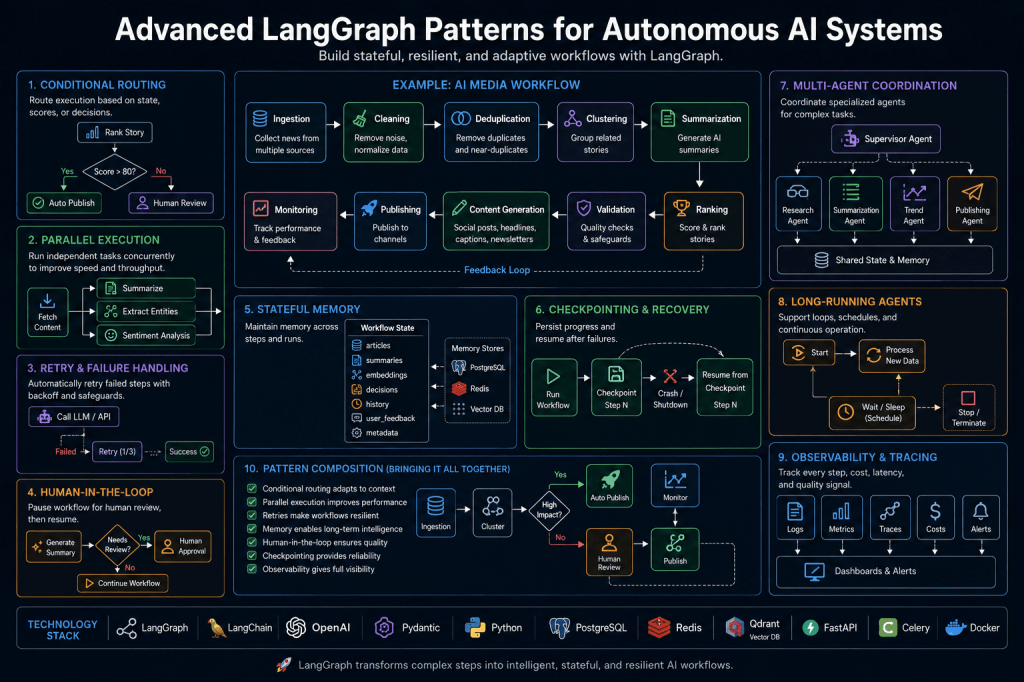
In this article, we will explore how LangGraph enables more sophisticated orchestration architectures for autonomous AI systems.
Why Basic Pipelines Eventually Break
A simple linear workflow might look like this:
Fetch → Summarize → Rank → Publish
This works initially.
But production systems quickly become more complicated.
For example:
- urgent news may require fast publishing
- low-confidence summaries may require human review
- failures may require retries
- large stories may require chunking
- expensive workflows may require caching
- social generation may run in parallel
The workflow becomes dynamic.
At that point:
- orchestration becomes critical
- state management becomes difficult
- debugging complexity increases rapidly
This is why graph-based orchestration is valuable.
Pattern 1 — Conditional Routing
One of the most powerful orchestration patterns is conditional execution.
Different workflow branches may execute depending on:
- confidence scores
- content categories
- engagement levels
- validation results
- human approval requirements
Example Conditional Routing
Imagine:
- high-impact AI stories publish automatically
- lower-confidence stories enter manual review
Example Router Function
def route_story(state): score = state["importance_score"] if score > 80: return "auto_publish" return "human_review"
This allows workflows to adapt dynamically.
LangGraph Conditional Edge
workflow.add_conditional_edges( "rank_story", route_story, { "auto_publish": "publish_node", "human_review": "review_node" })
This transforms static pipelines into intelligent systems.
Pattern 2 — Parallel Execution
Many AI workflows contain independent tasks.
For example:
- summarize article
- extract entities
- classify sentiment
- generate embeddings
These operations can often run simultaneously.
Parallel execution improves:
- latency
- throughput
- scalability
Example Parallel Workflow
                → Summarization
Fetch Content →
                → Entity Extraction
                → Sentiment Analysis
Why Parallelism Matters
Without parallel execution:
- workflows become slow
- token usage increases
- queues back up
- user-facing latency grows
Autonomous systems increasingly depend on async execution patterns.
Pattern 3 — Persistent State
One of LangGraph’s biggest strengths is stateful execution.
State persistence enables:
- long-running workflows
- memory systems
- checkpoint recovery
- workflow continuation
Example Stateful Workflow Data
{ "articles": [...], "summaries": [...], "embeddings": [...], "social_posts": [...], "workflow_status": "pending_review"}
Persistent state becomes essential when workflows:
- span multiple hours
- involve human approvals
- coordinate multiple agents
- survive infrastructure failures
Why Stateful Systems Matter
Most simple AI scripts are stateless.
They:
- receive input
- generate output
- terminate
Agentic systems are different.
They maintain:
- memory
- intermediate reasoning
- workflow history
- operational context
Stateful execution is one of the defining characteristics of autonomous AI systems.
Pattern 4 — Retry Orchestration
AI systems fail constantly.
Common failures include:
- API timeouts
- malformed JSON
- hallucinated structures
- scraping failures
- token limit errors
- rate limiting
Production systems must recover gracefully.
Simple Retry Logic
def retry_wrapper(fn, state, retries=3): for attempt in range(retries): try: return fn(state) except Exception as e: print(f"Retry attempt {attempt + 1}") raise Exception("Workflow failed")
Why Retries Are Dangerous
Poor retry systems can create:
- retry storms
- duplicate publishing
- runaway costs
- infrastructure overload
Good orchestration frameworks coordinate retries carefully.
Pattern 5 — Human-in-the-Loop Workflows
Fully autonomous publishing is risky.
AI systems may:
- hallucinate facts
- misinterpret sarcasm
- amplify misinformation
- publish incorrect summaries
Human review remains important in many workflows.
Human Review Architecture
AI Summary ↓Confidence Check ↓Human Approval Queue ↓Publish
Example Human Approval State
state["review_required"] = Truestate["review_status"] = "pending"
LangGraph workflows can pause execution until humans approve outputs.
This is extremely valuable for:
- editorial systems
- enterprise workflows
- compliance pipelines
- operational safety
Pattern 6 — Multi-Agent Coordination
Advanced AI systems increasingly involve multiple agents.
Example:
- Research agent
- Summarization agent
- Ranking agent
- Publishing agent
Each agent specializes in different tasks.
Multi-Agent Workflow Example
Research Agent ↓Summarization Agent ↓Trend Detection Agent ↓Publishing Agent
LangGraph provides a structured coordination layer between agents.
Why Multi-Agent Systems Matter
As workflows scale:
- specialization improves reliability
- modularity improves maintainability
- orchestration becomes more important
Modern AI systems increasingly resemble distributed software systems.
Pattern 7 — Workflow Checkpointing
Long-running workflows require checkpoint systems.
Without checkpoints:
- crashes lose progress
- retries repeat expensive tasks
- workflows become fragile
Example Checkpoint State
state["completed_steps"] = [ "fetch_news", "summarization"]
Checkpointing enables:
- workflow recovery
- resumable execution
- operational resilience
This becomes essential in production environments.
Pattern 8 — Supervisor Agents
Large systems often introduce supervisor agents.
Supervisor agents:
- monitor workflows
- detect failures
- reroute execution
- optimize resource usage
- coordinate sub-agents
Supervisor Workflow Example
Supervisor Agent ↓ ┌──────────────┐ ↓ ↓Research PublishingAgent Agent
This architecture resembles distributed orchestration systems.
Pattern 9 — Memory Systems
Autonomous AI systems increasingly require memory.
Examples:
- remembering previous summaries
- avoiding duplicate posts
- tracking long-term trends
- storing workflow history
Memory Example
state["previous_topics"] = [ "OpenAI model release", "GPU pricing trends"]
Memory systems enable:
- continuity
- personalization
- adaptive workflows
- long-term reasoning
Pattern 10 — Observability and Tracing
Complex workflows require visibility.
Without observability:
- debugging becomes impossible
- failures remain hidden
- costs become unpredictable
Production systems monitor:
- workflow duration
- token usage
- retries
- latency
- node failures
- publishing success
Example Observability Metrics
{ "workflow_duration": 12.4, "tokens_used": 18492, "retry_count": 2, "published_posts": 4}
Observability is one of the most overlooked aspects of AI engineering.
Recommended Production Stack
An advanced LangGraph architecture may include:
Orchestration
- LangGraph
- Celery
- Temporal
AI Layer
- OpenAI SDK
- Pydantic AI
- embedding models
Storage
- PostgreSQL
- Redis
- vector databases
Monitoring
- LangSmith
- Prometheus
- Grafana
- OpenTelemetry
Infrastructure
- Docker
- Kubernetes
- async workers
LangGraph becomes the orchestration backbone connecting these systems
Why LangGraph Is Important
The AI industry is shifting from:
- isolated prompts
toward:
- orchestrated intelligent systems
This transition introduces:
- workflow engineering
- state management
- operational reliability
- autonomous coordination
LangGraph provides a framework for building these systems in a structured way.
Final Thoughts
Modern AI systems are increasingly becoming:
- stateful
- orchestrated
- adaptive
- long-running
- multi-agent
As AI applications grow more autonomous, orchestration frameworks become foundational infrastructure.
By combining:
- conditional routing
- retries
- memory systems
- state persistence
- multi-agent coordination
- human review
- observability
developers can build autonomous AI systems capable of operating continuously and reliably at scale.
This is where AI applications evolve beyond prompts and into operational infrastructure.
And this is only the beginning of agentic system engineering.
 Agentic Media Lab
Leave a comment