One of the most valuable capabilities in modern AI media systems is trend detection.
The internet produces an overwhelming amount of information every minute:
- social media discussions
- AI model releases
- GitHub projects
- Reddit debates
- research papers
- newsletters
- videos
- blog posts
Most of this information disappears into noise.
Trend detection systems attempt to identify:
- what is accelerating
- what is gaining attention
- what matters now
- what may matter next
This is where AI agents become especially useful.
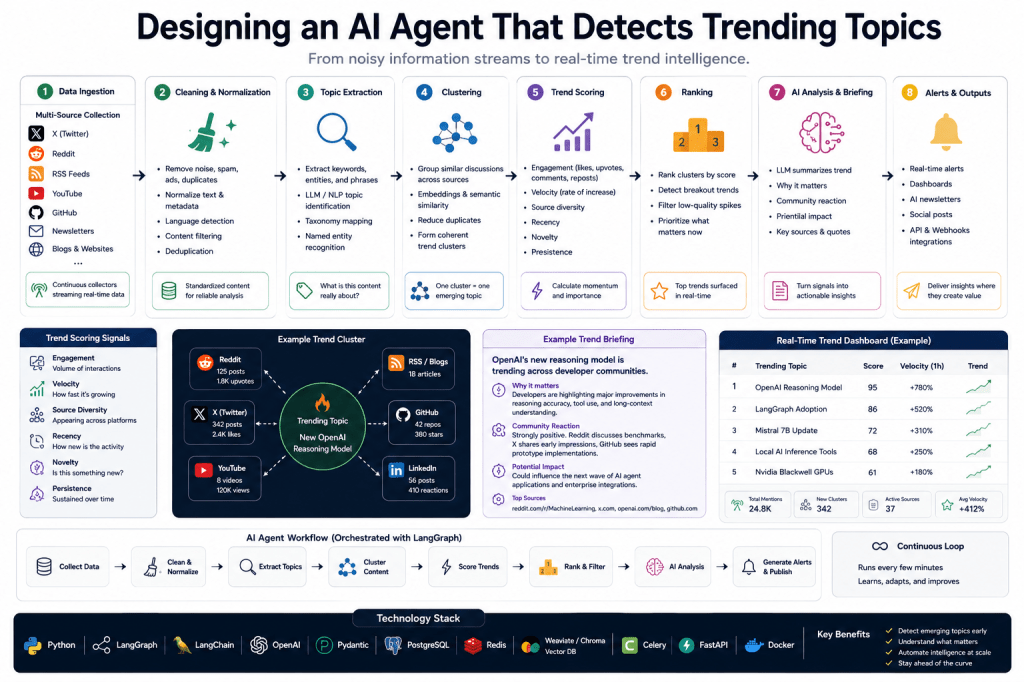
A trend detection agent continuously monitors information streams, analyzes signals across platforms, scores emerging topics, and surfaces the most important developments automatically.
In this article, we will design an AI-powered trend detection agent for autonomous media systems.
Why Trend Detection Matters
Traditional media systems are reactive.
They publish after stories become obvious.
Autonomous AI systems can become proactive.
A well-designed trend agent can:
- identify emerging discussions early
- detect unusual activity
- surface fast-growing topics
- track momentum shifts
- monitor industry attention
- prioritize important developments
This becomes valuable for:
- AI newsletters
- research briefings
- monitoring systems
- social media automation
- operational intelligence
- AI journalism pipelines
Trend detection transforms raw information into actionable awareness.
What Is a Trend?
A trend is not simply a popular topic.
A trend usually combines:
- velocity
- engagement
- novelty
- spread
- persistence
For example:
- 100 mentions over 30 days may not matter
- 100 mentions within 20 minutes may matter significantly
Trend systems focus heavily on acceleration.
High-Level Trend Detection Architecture
Our trend detection agent will follow this architecture:
RSS / Reddit / X / YouTube ↓Ingestion Pipeline ↓Cleaning & Deduplication ↓Topic Extraction ↓Clustering ↓Trend Scoring ↓Ranking Engine ↓AI Summary Generation ↓Alerts / Dashboards / Publishing
Each layer contributes to identifying meaningful signals from noisy information streams.
Step 1 — Collecting Multi-Source Data
Trend detection requires multiple information sources.
A single platform rarely provides enough signal diversity.
Recommended Sources
Social Platforms
- X/Twitter
- Bluesky
Technical Sources
- GitHub
- Hugging Face
- arXiv
- AI blogs
Media Sources
- RSS feeds
- newsletters
- YouTube transcripts
- podcasts
Different sources reveal different types of momentum.
Why Multi-Source Detection Matters
For example:
- X may detect hype first
- Reddit may reveal technical depth
- GitHub may indicate developer adoption
- YouTube may indicate mainstream interest
The strongest systems combine all signals together.
Step 2 — Normalizing Incoming Data
Different platforms expose inconsistent structures.
Normalization standardizes information before analysis.
Example Pydantic Model
from pydantic import BaseModelfrom typing import Optionalclass ContentItem(BaseModel): source: str title: Optional[str] content: Optional[str] author: Optional[str] engagement_score: int = 0 published: Optional[str]
This consistent structure simplifies downstream workflows.
Step 3 — Extracting Topics
The system now needs to identify what each post or article is about.
This is often called topic extraction.
Example Topics
A single AI news item may contain:
- OpenAI
- multimodal models
- reasoning systems
- inference optimization
- GPUs
Topic extraction creates semantic structure.
Simple Keyword Extraction Example
KEYWORDS = [ "OpenAI", "LangGraph", "AI agents", "reasoning models"]def extract_topics(text): found = [] for keyword in KEYWORDS: if keyword.lower() in text.lower(): found.append(keyword) return found
Production systems often use:
- embeddings
- entity extraction
- NLP pipelines
- topic modeling
instead of keyword matching.
Step 4 — Clustering Related Discussions
Trend systems should group related discussions together.
For example:
- RSS article
- Reddit thread
- X discussion
- YouTube analysis
may all refer to the same underlying event.
Why Clustering Matters
Without clustering:
- trends become fragmented
- duplicate stories dominate rankings
- engagement signals become distorted
Clustering creates coherent trend groups.
Example Cluster
Trend Cluster:- New OpenAI reasoning model- Reddit benchmark discussion- X developer reactions- GitHub implementation repo
This cluster now becomes a candidate trend.
Step 5 — Calculating Trend Scores
This is the core intelligence layer.
The agent must determine:
- what is gaining momentum
- what is important
- what deserves attention
Core Trend Signals
Engagement
Likes, comments, reposts, upvotes.
Velocity
How quickly discussion volume increases.
Source Diversity
Appearing across multiple platforms.
Recency
Newer discussions receive higher weight.
Novelty
Is this a genuinely new topic?
Persistence
Does the topic continue growing?
Example Trend Score Formula
def calculate_trend_score( engagement, velocity, source_count, recency): return ( engagement * 0.4 + velocity * 0.3 + source_count * 0.2 + recency * 0.1 )
Production systems continuously tune scoring logic.
Why Velocity Is Important
Velocity often matters more than raw popularity.
Example:
- 500 mentions over 2 weeks = stable discussion
- 500 mentions in 30 minutes = breaking trend
Acceleration is one of the strongest indicators of emerging topics.
Step 6 — Using AI for Trend Understanding
Traditional analytics systems only count activity.
AI systems can interpret meaning.
This is where LLMs become extremely valuable.
Example AI Tasks
AI can:
- summarize trends
- classify importance
- detect sentiment
- explain why a topic matters
- identify emerging narratives
Example AI Trend Prompt
PROMPT = """Analyze the following AI discussions.Identify:1. The emerging topic2. Why it matters3. Community reaction4. Potential industry impact"""
This transforms trend detection from:
- analytics
into:
- intelligence generation
Step 7 — Ranking Trends
Not all trends deserve equal visibility.
A ranking system prioritizes:
- important trends
- fast-growing discussions
- technically significant developments
Example Ranking Output
1. OpenAI releases new reasoning model2. LangGraph adoption accelerates3. New GPU benchmark discussions emerge4. Local AI deployment tools trending
These ranked trends can feed:
- dashboards
- newsletters
- social posts
- alerts
- autonomous publishing systems
Step 8 — Generating Trend Briefings
The system can now generate AI summaries automatically.
Example Briefing Output
Trend Alert:Discussion around OpenAI’s latest reasoning model increased rapidly across Reddit, X, and GitHub over the last 12 hours. Developers focused heavily on inference speed improvements and structured reasoning capabilities, while community sentiment remained strongly positive.
This is where trend analysis becomes operational intelligence.
Step 9 — Real-Time Monitoring
Trend detection systems are most powerful when continuously active.
Production systems often run:
- every minute
- every 5 minutes
- continuously through queues
Continuous Monitoring Architecture
Collectors ↓Queue ↓Processing Workers ↓Trend Engine ↓AI Analysis ↓Publishing & Alerts
This architecture supports:
- scalability
- resilience
- fault tolerance
- asynchronous execution
Why LangGraph Fits Trend Detection Well
Trend systems are highly workflow-oriented.
They involve:
- ingestion
- preprocessing
- clustering
- scoring
- AI reasoning
- publishing
This makes LangGraph orchestration extremely useful.
Example LangGraph Workflow
Collect Data ↓Extract Topics ↓Cluster Discussions ↓Calculate Scores ↓Generate AI Briefing ↓Publish Alert
Each node can:
- maintain state
- retry failures
- branch conditionally
- coordinate workflows
This is classic agentic architecture.
Recommended Production Stack
A modern trend detection system may include:
AI Layer
- OpenAI SDK
- LangGraph
- Pydantic AI
Data Layer
- PostgreSQL
- Redis
- vector databases
Crawling Layer
- Playwright
- RSS ingestion
- API collectors
Monitoring
- Prometheus
- Grafana
- logging systems
Infrastructure
- Docker
- async workers
- queues
Trend systems quickly evolve into distributed infrastructure systems.
Common Challenges
Noise
Most internet discussions are low quality.
Duplicate Discussions
The same story spreads across platforms.
Bot Amplification
Artificial engagement can distort signals.
API Limits
External sources throttle aggressively.
False Trends
Short spikes may not represent meaningful developments.
Hallucinated AI Analysis
LLMs may overstate trend importance.
Reliable trend systems require careful validation.
Why Trend Detection Is Valuable
Trend detection agents represent one of the most useful real-world applications of AI orchestration.
They combine:
- ingestion pipelines
- AI reasoning
- ranking systems
- orchestration
- observability
- autonomous workflows
in a single continuously operating architecture.
This makes them ideal examples of modern agentic systems.
Final Thoughts
The internet produces more information than humans can process manually.
Trend detection agents help transform:
- fragmented discussions
into:
- structured awareness
By combining:
- multi-source ingestion
- clustering
- scoring
- AI summarization
- orchestration workflows
developers can build autonomous systems capable of identifying important developments in real time.
This is where AI systems evolve from:
- passive tools
into:
- active intelligence systems
And this is only the beginning of autonomous AI media engineering.
👉 You can experiment with a practical AI News System implementation of this concept in the official GitHub repository for the AgenticMediaLab: https://github.com/BenardoKemp/agentic-media-lab
 Agentic Media Lab
Leave a comment