One of the most practical applications of autonomous AI systems is automated social media generation.
Modern AI workflows can now:
- monitor information streams
- detect trends
- summarize discussions
- generate content
- publish updates automatically
This transforms AI systems from passive tools into active publishing infrastructures.
At AgenticMediaLab, automated social generation is one of the key operational layers in our AI media pipeline.
In this article, we will explore how we design AI systems that automatically generate:
- LinkedIn posts
- X/Twitter updates
- Bluesky posts
- newsletter snippets
- AI briefings
using orchestration workflows, structured outputs, and trend-aware AI pipelines.
Why Automated Social Generation Matters
The internet moves faster than humans can manually summarize.
AI media systems may process:
- thousands of posts
- breaking AI releases
- GitHub updates
- Reddit discussions
- research announcements
- benchmark results
every day.
Without automation:
- important stories get missed
- publishing becomes inconsistent
- latency increases
- manual workload explodes
AI-generated publishing systems help transform:
- information overload
into:
- structured communication
in real time.
High-Level Architecture
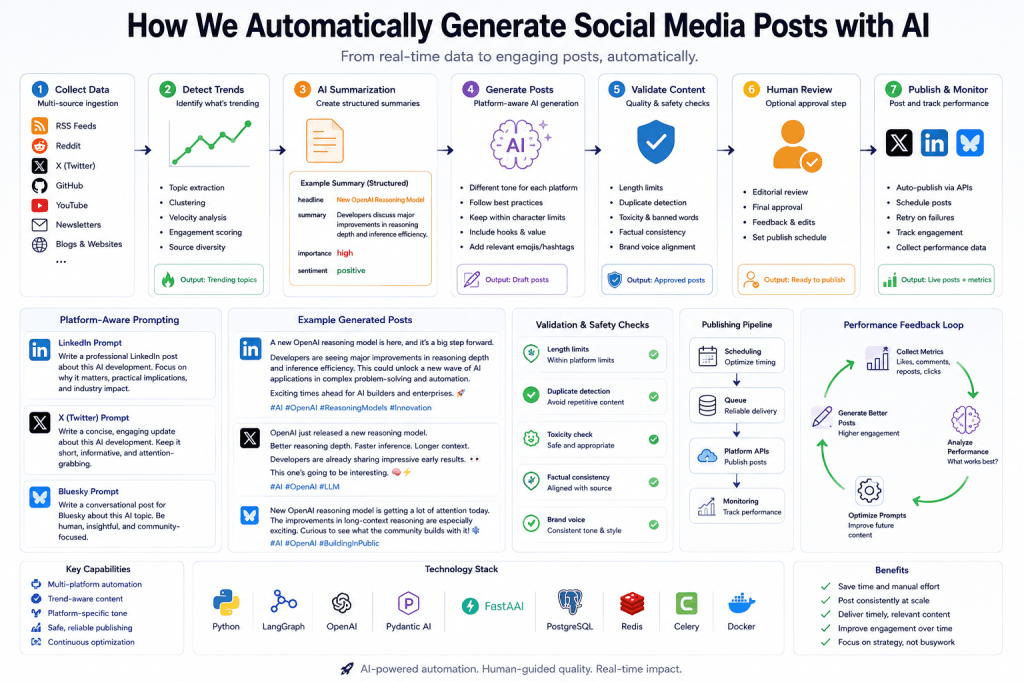
Our social generation pipeline looks roughly like this:
Data Sources ↓Trend Detection ↓AI Summarization ↓Ranking & Filtering ↓Social Post Generation ↓Validation ↓Publishing Queue ↓Social Platforms
Each stage contributes to quality, reliability, and operational safety.
Step 1 — Collecting High-Quality Inputs
The quality of generated posts depends heavily on the quality of the input data.
We first ingest information from:
- RSS feeds
- X/Twitter
- GitHub
- AI newsletters
- YouTube transcripts
The system then:
- removes duplicates
- filters low-quality content
- clusters related discussions
- ranks trending topics
Only high-quality clusters move into content generation.
Why Filtering Matters
Without filtering:
- repetitive posts appear
- irrelevant stories get published
- low-value discussions dominate feeds
AI publishing systems are only as good as their upstream signal quality.
Step 2 — Creating Structured AI Summaries
Before generating social posts, the system creates structured summaries.
Example Summary Schema
from pydantic import BaseModelclass TrendSummary(BaseModel): headline: str summary: str importance: str sentiment: str
Example output:
{ "headline": "New OpenAI Reasoning Model Released", "summary": "Developers discuss major improvements in reasoning depth and inference efficiency.", "importance": "high", "sentiment": "positive"}
Structured summaries improve downstream automation reliability.
Why Structured Outputs Matter
Unstructured AI outputs are difficult to:
- validate
- monitor
- automate
- publish safely
Structured schemas create predictable workflows.
This is one reason Pydantic AI is extremely valuable in production systems.
Step 3 — Platform-Aware Post Generation
Different social platforms require different writing styles.
For example:
- professional
- analytical
- slightly longer
- business-oriented
X/Twitter
- concise
- fast-paced
- attention-focused
Bluesky
- conversational
- community-driven
- technical-friendly
The system generates different outputs for each platform.
Example Platform Prompt
LINKEDIN_PROMPT = """Write a professional LinkedIn post about this AI development.Focus on:- why it matters- practical implications- industry impactKeep the tone professional and insightful."""
Example X/Twitter Prompt
X_PROMPT = """Write a concise social media update about this AI development.Keep it:- short- engaging- informative- technically accurate"""
Prompt specialization improves platform performance significantly.
Step 4 — Generating Posts with OpenAI
Once prompts are prepared, the system generates content.
Example OpenAI Call
from openai import OpenAIclient = OpenAI()def generate_post(prompt, summary): response = client.chat.completions.create( model="gpt-4.1-mini", messages=[ { "role": "system", "content": prompt }, { "role": "user", "content": summary } ] ) return response.choices[0].message.content
Example Generated Output
AI infrastructure is rapidly evolving.A newly released reasoning model is generating strong developer interest due to improved inference efficiency and long-context capabilities.This could significantly impact autonomous AI workflow design and enterprise AI systems.
This output can now enter validation workflows.
Step 5 — Preventing Repetitive Posts
One major challenge in AI publishing systems is repetition.
Without safeguards:
- posts sound identical
- tone becomes robotic
- feeds lose authenticity
Production systems often track:
- previous outputs
- phrases
- recent topics
- post templates
to reduce repetition.
Example Duplicate Check
def is_duplicate(post, previous_posts): return post in previous_posts
More advanced systems use:
- embeddings
- semantic similarity
- style variation scoring
to improve diversity.
Step 6 — AI Validation Layer
Autonomous publishing systems require validation.
LLMs may:
- hallucinate facts
- exaggerate claims
- generate misleading summaries
- produce low-quality posts
Validation systems help reduce risk.
Example Validation Rules
The system may check:
- length limits
- banned phrases
- factual consistency
- duplicate content
- toxicity
- formatting
Example Validation Function
def validate_post(post): if len(post) > 280: return False if "guaranteed" in post.lower(): return False return True
Production systems often combine:
- rules
- AI validators
- human review
for safer publishing.
Step 7 — Human-in-the-Loop Review
Fully autonomous publishing remains risky.
Many workflows include:
- manual approval queues
- moderation systems
- editorial review
before publication.
Human Review Workflow
Generated Post ↓AI Validation ↓Human Approval ↓Publishing Queue
This architecture improves:
- reliability
- brand safety
- editorial control
Step 8 — Scheduling and Publishing
Once approved, posts enter a publishing queue.
The system may:
- stagger publishing
- optimize timing
- retry failed posts
- rate limit API calls
Example Queue Architecture
AI Generator ↓Validation Queue ↓Publishing Scheduler ↓Platform APIs
This creates a scalable publishing pipeline.
Step 9 — Tracking Performance
Autonomous publishing systems should monitor:
- engagement
- click-through rates
- impressions
- reposts
- comments
- velocity
These signals help improve future generations.
Example Metrics
{ "likes": 128, "comments": 24, "reposts": 31, "engagement_rate": 8.2}
Performance tracking enables adaptive AI systems.
Step 10 — Feedback Loops
The best systems continuously learn.
For example:
- high-performing posts influence future prompts
- low-performing styles get deprioritized
- engagement signals influence ranking systems
This creates a feedback loop between:
- publishing
- monitoring
- generation
Example Feedback Architecture
Generated Posts ↓Performance Metrics ↓Prompt Optimization ↓Future Content Generation
This is where AI media systems become adaptive systems.
Why LangGraph Fits Publishing Pipelines Well
Publishing systems involve:
- orchestration
- retries
- queues
- branching logic
- state persistence
- human approval
- monitoring
LangGraph coordinates these workflows effectively.
Example LangGraph Workflow
Trend Detection ↓Generate Summary ↓Generate Social Posts ↓Validate Content ↓Human Review ↓Publish
Each node can:
- retry failures
- maintain state
- branch conditionally
- log metrics
This transforms simple scripts into operational systems.
Recommended Production Stack
A production social generation system may use:
AI Layer
- OpenAI SDK
- LangGraph
- Pydantic AI
Backend
- FastAPI
- PostgreSQL
- Redis
Scheduling
- Celery
- APScheduler
Monitoring
- Prometheus
- Grafana
- tracing systems
Deployment
- Docker
- async workers
- cloud queues
These systems increasingly resemble distributed infrastructure platforms.
Common Challenges
Hallucinations
AI may invent information.
Repetition
Generated posts may become formulaic.
Tone Drift
Brand voice may become inconsistent.
Platform Rules
Each platform has unique limitations.
API Reliability
Publishing APIs fail regularly.
Engagement Bias
Algorithms may reward low-quality sensationalism.
Autonomous publishing requires careful operational design.
Why Automated Publishing Matters
AI-generated publishing systems represent a major shift in media infrastructure.
They combine:
- ingestion
- AI reasoning
- orchestration
- validation
- scheduling
- monitoring
into continuously operating workflows.
This is one of the clearest examples of agentic AI systems in practice.
Final Thoughts
The future of AI media systems is not only:
- content generation
It is:
- coordinated publishing infrastructure
By combining:
- trend detection
- AI summarization
- structured outputs
- orchestration workflows
- validation systems
- adaptive feedback loops
developers can build autonomous systems capable of continuously generating and distributing information at scale.
This is where AI systems evolve from:
- isolated assistants
into:
- operational media architectures
And this is only the beginning of autonomous publishing engineering.
👉 You can experiment with a practical AI News System implementation of this concept in the official GitHub repository for the AgenticMediaLab: https://github.com/BenardoKemp/agentic-media-lab
 Agentic Media Lab
Leave a comment