One of the biggest surprises developers encounter when building autonomous AI systems is how quickly token costs accumulate.
A single AI call may seem inexpensive.
But autonomous pipelines often perform:
- ingestion
- summarization
- ranking
- validation
- embeddings
- classification
- social generation
- retries
- monitoring
continuously and at scale.
Without visibility into token consumption, AI systems can become:
- unpredictable
- expensive
- difficult to optimize
- operationally risky
This is why token tracking is a foundational part of AI infrastructure engineering.
At AgenticMediaLab, token observability is treated as a core operational layer of the system.
In this article, we will explore how to track, monitor, and optimize token costs in autonomous AI pipelines.
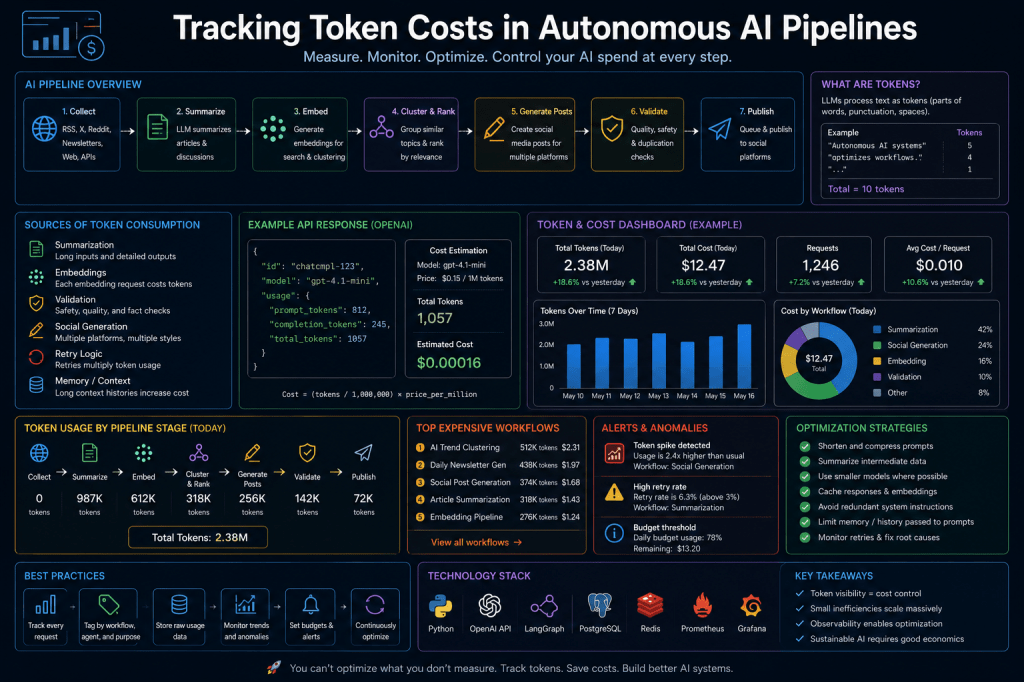
Why Token Tracking Matters
Most AI tutorials focus on prompts.
Production systems focus on economics.
Every:
- completion
- embedding
- retry
- validation step
- orchestration loop
consumes tokens.
As workflows scale, token usage becomes one of the largest operational concerns.
Example Autonomous Workflow
A simple AI media pipeline may perform:
Collect News ↓Summarize Articles ↓Generate Embeddings ↓Cluster Topics ↓Generate Social Posts ↓Validate Outputs ↓Publish
Each stage may involve multiple LLM calls.
Now multiply this by:
- thousands of articles
- retries
- multi-platform outputs
- scheduled workflows
The costs scale rapidly.
Understanding Tokens
LLMs process text as tokens rather than words.
Tokens include:
- words
- punctuation
- whitespace fragments
- subword units
For example:
"Autonomous AI systems"
may become several tokens internally.
Why Token Size Matters
Larger prompts create:
- higher costs
- slower latency
- larger context windows
- more infrastructure load
Efficient AI systems optimize token usage aggressively.
Typical Sources of Token Consumption
In autonomous pipelines, token usage often comes from:
Summarization
Summarizing articles, transcripts, and discussions.
Embeddings
Generating vector representations for search and clustering.
Validation
Checking outputs for quality and safety.
Social Generation
Creating platform-specific posts.
Retry Logic
Repeated failed executions.
Memory Systems
Passing long workflow histories into prompts.
Many developers underestimate how quickly orchestration increases token volume.
Example Token Explosion
A simple workflow may look like:
1 article → 1 summary → 1 social post
But production systems often become:
1 article ↓summary ↓embedding ↓classification ↓ranking ↓social generation ↓validation ↓retry
A single content item may generate thousands of tokens internally.
High-Level Token Tracking Architecture
A modern observability pipeline may look like this:
AI Requests ↓Token Logger ↓Metrics Storage ↓Dashboards ↓Alerts & Analytics
This enables:
- cost visibility
- optimization
- anomaly detection
- operational forecasting
Step 1 — Capturing Token Usage
Most modern AI APIs expose token usage metrics.
Example OpenAI Usage Data
response = client.chat.completions.create( model="gpt-4.1-mini", messages=messages)usage = response.usageprint(usage)
Example output:
{ "prompt_tokens": 812, "completion_tokens": 245, "total_tokens": 1057}
This becomes the foundation of observability.
Step 2 — Logging Token Metrics
Production systems should persist token usage data.
Example Token Logger
def log_token_usage(workflow, usage): print({ "workflow": workflow, "prompt_tokens": usage.prompt_tokens, "completion_tokens": usage.completion_tokens, "total_tokens": usage.total_tokens })
Real systems often store this data in:
- PostgreSQL
- Redis
- time-series databases
- observability platforms
Why Logging Matters
Without logging:
- costs become invisible
- debugging becomes difficult
- optimization becomes impossible
Token observability is infrastructure observability.
Step 3 — Calculating Cost per Request
Once token counts are known, estimated cost becomes easy to calculate.
Example Cost Function
def estimate_cost(tokens, price_per_million): return (tokens / 1_000_000) * price_per_million
Example:
cost = estimate_cost(1057, 0.15)print(cost)
This helps forecast operational expenses.
Step 4 — Tracking Workflow-Level Costs
Single requests are rarely enough.
Modern AI systems require:
- workflow-level accounting
- agent-level accounting
- pipeline-level accounting
Example Workflow Metrics
{ "workflow": "daily_ai_briefing", "requests": 48, "tokens_used": 182493, "estimated_cost": 2.84}
This enables:
- optimization analysis
- budget forecasting
- anomaly detection
Step 5 — Building Token Dashboards
Observability improves dramatically when metrics become visual.
Useful Dashboard Metrics
Total Tokens Per Day
Tracks system growth.
Cost Per Workflow
Identifies expensive pipelines.
Average Prompt Size
Reveals prompt inflation.
Retry Costs
Shows operational inefficiencies.
Most Expensive Agents
Highlights optimization opportunities.
Example Monitoring Dashboard
Daily Tokens Used: 2.4MAverage Workflow Cost: $0.12Most Expensive Workflow: AI Trend ClusteringRetry Rate: 4.1%
Dashboards transform invisible costs into actionable engineering insights.
Step 6 — Detecting Token Spikes
Autonomous systems require anomaly detection.
Unexpected token spikes may indicate:
- runaway loops
- malformed prompts
- recursive workflows
- retry storms
- prompt injection attacks
Example Alert Rule
if total_tokens > 1_000_000: send_alert("High token usage detected")
This becomes critical in long-running systems.
Step 7 — Optimizing Prompt Size
One of the easiest optimization strategies is prompt reduction.
Large prompts increase:
- costs
- latency
- failure rates
Common Optimization Strategies
Remove Redundant Instructions
Avoid repeated system prompts.
Shorten Workflow Memory
Limit historical context.
Compress Input Data
Reduce unnecessary metadata.
Summarize Intermediate Outputs
Prevent prompt growth.
Use Smaller Models
Reserve expensive models for critical tasks.
Example Prompt Compression
Instead of:
Here is the full Reddit discussion thread...
Use:
Summarized Reddit discussion:- developers praise inference speed- concerns about hallucinations- strong benchmark interest
This dramatically reduces token usage.
Step 8 — Caching Responses
Caching prevents repeated AI calls.
This is one of the highest-impact optimizations.
Example Cache Logic
cache = {}def cached_summary(text): if text in cache: return cache[text] summary = summarize(text) cache[text] = summary return summary
Caching improves:
- cost efficiency
- latency
- throughput
Step 9 — Tracking Retry Costs
Retries are often hidden cost amplifiers.
A failed workflow may:
- repeat prompts
- duplicate embeddings
- regenerate outputs
without developers noticing.
Example Retry Metrics
{ "workflow": "social_generation", "retry_count": 3, "retry_tokens": 18422}
Tracking retries reveals operational inefficiencies.
Step 10 — Token Budgets
Advanced systems often enforce budgets.
Example:
- max tokens per workflow
- max tokens per user
- max daily pipeline usage
Example Budget Check
if workflow_tokens > TOKEN_LIMIT: stop_workflow()
Budgets protect infrastructure from runaway costs.
Why LangGraph Makes Token Tracking Easier
LangGraph workflows already maintain:
- state
- execution paths
- node transitions
This makes token tracking more structured.
Each node can log:
- token usage
- retries
- latency
- costs
Example Workflow Metrics
Fetch News → 0 tokensSummarization → 28K tokensClustering → 14K tokensSocial Generation → 8K tokensValidation → 6K tokens
This creates workflow-level observability.
Recommended Observability Stack
A production AI observability stack may include:
Metrics Collection
- Prometheus
- OpenTelemetry
Visualization
- Grafana
- custom dashboards
Logging
- PostgreSQL
- Redis
- Elasticsearch
AI Monitoring
- LangSmith
- custom tracing systems
Alerting
- Slack alerts
- Discord alerts
- email notifications
AI pipelines increasingly resemble distributed infrastructure systems.
Common Cost Problems
Prompt Inflation
Prompts grow over time.
Memory Explosion
Long context histories increase costs.
Retry Storms
Failed workflows multiply usage.
Recursive Agents
Loops create uncontrolled token consumption.
Overpowered Models
Expensive models used unnecessarily.
Duplicate Processing
The same content processed repeatedly.
Most AI systems become significantly more expensive than developers initially expect.
Why Token Tracking Is Strategic
Token tracking is not just accounting.
It affects:
- architecture decisions
- orchestration design
- workflow efficiency
- scaling strategies
- infrastructure reliability
AI observability is becoming one of the most important disciplines in production AI engineering.
Final Thoughts
Autonomous AI systems are fundamentally operational systems.
As workflows scale, token visibility becomes essential for:
- cost control
- optimization
- reliability
- forecasting
- debugging
- infrastructure safety
By combining:
- token logging
- workflow metrics
- dashboards
- anomaly detection
- caching
- budget enforcement
developers can build AI systems that remain economically sustainable at scale.
The future of AI engineering is not only about:
- smarter models
It is also about:
- efficient infrastructure
- observability
- operational discipline
- sustainable orchestration
This is where AI applications evolve into production-grade systems.
👉 You can experiment with a practical AI News System implementation of this concept in the official GitHub repository for the AgenticMediaLab: https://github.com/BenardoKemp/agentic-media-lab
 Agentic Media Lab