As AI systems evolve from:
- isolated scripts
into:
- autonomous workflows
- operational pipelines
- continuously running systems
data architecture becomes critically important.
Many beginner AI projects store information:
- in memory
- in JSON files
- inside notebooks
That works initially.
But production AI systems quickly require:
- structured persistence
- workflow tracking
- observability
- retries
- embeddings
- operational history
- scalable querying
At AgenticMediaLab, PostgreSQL becomes the central operational database for the autonomous AI pipeline.
In this article, we will design the first production-oriented PostgreSQL schema for:
- AI news ingestion
- summarization workflows
- embeddings
- trend detection
- observability
- token tracking
This is where the project begins evolving into real infrastructure.
Why PostgreSQL?
There are many database options available:
PostgreSQL was chosen because it provides:
- reliability
- mature tooling
- structured schemas
- excellent scalability
- strong relational modeling
- JSON support
- vector extension support via pgvector
Modern AI systems increasingly rely on PostgreSQL as operational infrastructure.
Why AI Systems Need Databases
Autonomous AI systems generate enormous operational data.
Examples include:
- collected articles
- summaries
- embeddings
- workflow states
- retries
- failures
- metrics
- token usage
- publishing history
Without structured persistence:
- workflows become fragile
- debugging becomes difficult
- observability becomes impossible
Databases become the memory layer of operational AI systems.
High-Level Data Architecture
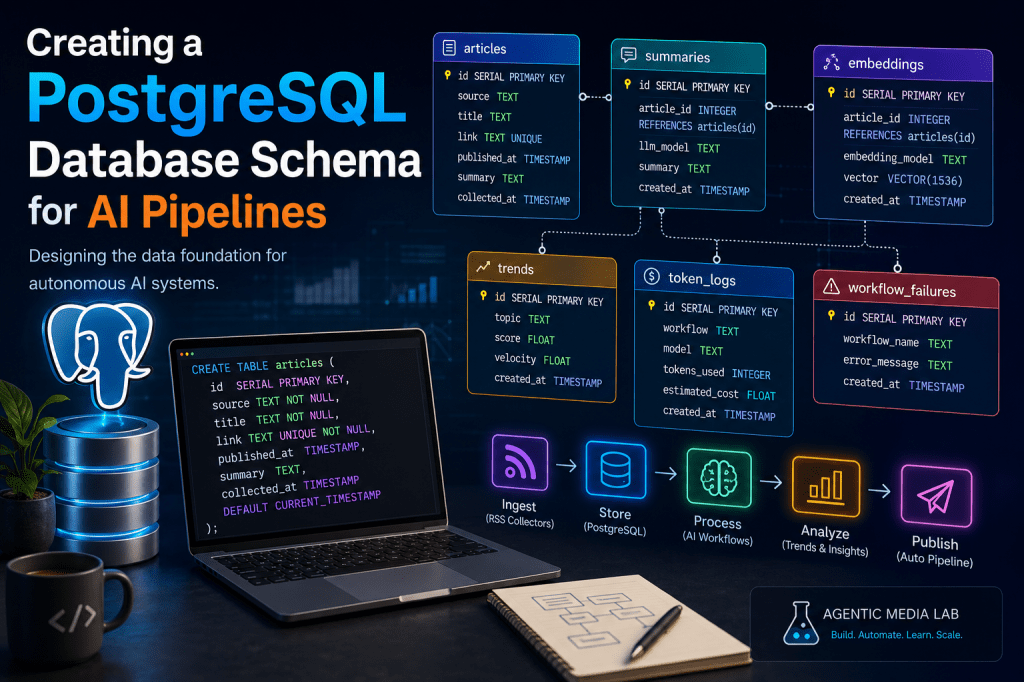
The initial database architecture looks like this:
Articles ↓Summaries ↓Embeddings ↓Trend Scores ↓Publishing Pipelines ↓Observability Metrics
Each layer contributes to the larger autonomous system.
Initial Database Structure
Inside the repository:
database/│├── schema.sql├── migrations/├── models/└── seeds/
This separates:
- schema definitions
- migration logic
- ORM models
- seed data
Connecting to PostgreSQL
Install dependency:
pip install psycopg2-binary
Basic Connection Example
Create:
database/connect.py
Example:
import psycopg2connection = psycopg2.connect( host="localhost", database="agentic_media_lab", user="postgres", password="password")print("Connected successfully")
Run:
python database/connect.py
If successful:
Connected successfully
Your infrastructure stack is now connected to the database layer.
The First Core Table — Articles
The ingestion pipeline revolves around collected articles.
Create:
database/schema.sql
Articles Table
CREATE TABLE articles ( id SERIAL PRIMARY KEY, source TEXT NOT NULL, title TEXT NOT NULL, link TEXT UNIQUE NOT NULL, published_at TIMESTAMP, summary TEXT, collected_at TIMESTAMP DEFAULT CURRENT_TIMESTAMP);
Why These Fields Matter
source
Tracks where content originated.
Examples:
title
Primary article headline.
Used for:
- ranking
- deduplication
- embeddings
link
Unique identifier for ingestion deduplication.
This prevents duplicate inserts.
published_at
Tracks original publication timing.
Important for:
- trend detection
- recency analysis
- ranking systems
collected_at
Tracks when the pipeline ingested the content.
Useful for:
- observability
- latency analysis
- debugging
Creating the Table
Run:
psql -U postgres -d agentic_media_lab -f database/schema.sql
This creates the first operational table.
Inserting Data from Python
Create:
database/insert_article.py
Example:
import psycopg2connection = psycopg2.connect( host="localhost", database="agentic_media_lab", user="postgres", password="password")cursor = connection.cursor()query = """INSERT INTO articles ( source, title, link)VALUES (%s, %s, %s)"""cursor.execute(query, ( "OpenAI", "New AI Workflow Released", "https://example.com"))connection.commit()print("Article inserted")
Why Parameterized Queries Matter
Never build SQL queries using string concatenation.
Parameterized queries improve:
- security
- reliability
- escaping
- injection protection
Even experimental projects should follow safe database practices.
Adding a Summaries Table
Autonomous systems generate AI summaries.
These summaries should remain separate from raw articles.
Summaries Schema
CREATE TABLE summaries ( id SERIAL PRIMARY KEY, article_id INTEGER REFERENCES articles(id), llm_model TEXT, summary TEXT NOT NULL, created_at TIMESTAMP DEFAULT CURRENT_TIMESTAMP);
Why Separate Summaries?
This enables:
- multiple summary versions
- model comparisons
- workflow experimentation
- auditing
The same article may eventually have:
- GPT-4 summary
- fallback summary
- condensed summary
- social summary
Database normalization becomes important.
Embeddings Table
AI systems increasingly rely on embeddings.
Embeddings power:
- semantic search
- clustering
- trend detection
- retrieval systems
Basic Embeddings Schema
CREATE TABLE embeddings ( id SERIAL PRIMARY KEY, article_id INTEGER REFERENCES articles(id), embedding_model TEXT, created_at TIMESTAMP DEFAULT CURRENT_TIMESTAMP);
Later this will evolve using:
- pgvector
- vector indexing
- similarity search
Trend Tracking Table
Trend systems require operational scoring.
Example schema:
CREATE TABLE trends ( id SERIAL PRIMARY KEY, topic TEXT NOT NULL, score FLOAT, velocity FLOAT, created_at TIMESTAMP DEFAULT CURRENT_TIMESTAMP);
This enables:
- ranking
- trend evolution
- scoring history
Why Historical Data Matters
Autonomous systems improve through history.
Historical records enable:
- analytics
- debugging
- ranking improvements
- observability
- retraining pipelines
AI systems increasingly become data systems.
Token Tracking Table
Observability is essential.
Example:
CREATE TABLE token_logs ( id SERIAL PRIMARY KEY, workflow TEXT, model TEXT, tokens_used INTEGER, estimated_cost FLOAT, created_at TIMESTAMP DEFAULT CURRENT_TIMESTAMP);
Why Token Tracking Matters
Without tracking:
- costs become invisible
- retries become dangerous
- workflows become unpredictable
Operational AI systems require cost visibility.
Failure Logging Table
Production systems fail continuously.
Tracking failures is essential.
Failure Schema
CREATE TABLE workflow_failures ( id SERIAL PRIMARY KEY, workflow_name TEXT, error_message TEXT, created_at TIMESTAMP DEFAULT CURRENT_TIMESTAMP);
This supports:
- observability
- retries
- debugging
- operational analysis
Why AI Systems Need Observability
Most AI tutorials ignore:
- metrics
- failures
- retries
- operational tracking
Real systems depend heavily on these layers.
Observability becomes one of the most important infrastructure disciplines.
Recommended Initial Architecture
At this stage the system becomes:
RSS Collectors ↓PostgreSQL ↓AI Summarization ↓Embeddings ↓Trend Detection ↓Publishing Workflows
The database acts as the central operational memory layer.
Why PostgreSQL Works So Well for AI Systems
PostgreSQL supports:
- structured data
- relational models
- JSON fields
- vector extensions
- indexing
- transactions
- analytics
This flexibility makes it ideal for:
- AI orchestration
- autonomous workflows
- operational pipelines
The Future — pgvector
Soon the system will evolve toward:
- semantic search
- embeddings
- clustering
- retrieval systems
This is where:
- pgvector
- vector indexing
- similarity search
become important.
PostgreSQL can eventually operate as:
- relational database
- vector store
- operational analytics engine
inside one infrastructure layer.
One Important Engineering Lesson
Many AI developers initially focus only on:
- prompts
- model quality
But operational systems depend heavily on:
- database design
- observability
- workflow persistence
- historical state
- reliability
Data architecture becomes foundational infrastructure.
What Comes Next
The next infrastructure layers will introduce:
- Redis queues
- Celery workers
- LangGraph orchestration
- embeddings
- trend scoring
- autonomous publishing systems
The platform is gradually evolving into a real autonomous AI infrastructure stack.
Final Thoughts
PostgreSQL is far more than:
- simple storage
inside modern AI systems.
It becomes:
- operational memory
- observability infrastructure
- workflow persistence
- analytics foundation
- orchestration support
As autonomous AI systems grow more complex, database architecture becomes one of the most important engineering layers in the entire stack.
And this PostgreSQL schema is the beginning of that infrastructure foundation inside AgenticMediaLab.
 Agentic Media Lab